A team of astronomers believes it has detected the most distant galaxies, at the dawn of the universe.
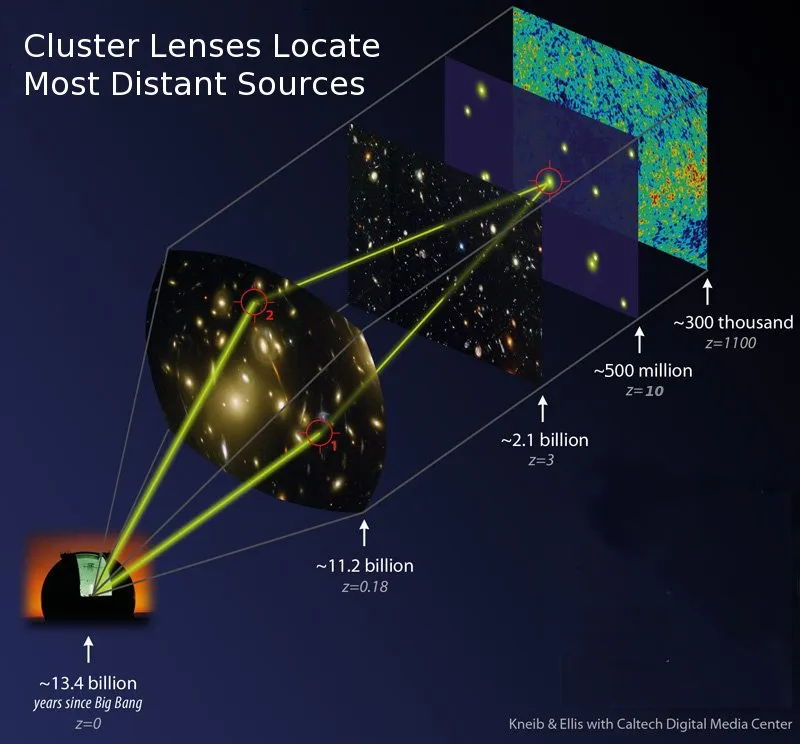
Diagram of the operation of gravitational lenses. Z is the redshift.
Previously, the most distant known galaxies that had been found had a redshift of 7- corresponding to when the universe was only 750 million years old.
Now, astronomers led by Daniel Stark of Caltech, found several galaxies with a redshift of 9, which corresponds to just 500 million years after the Big Bang, 4% of the universe's age of 13.7 billion years.
The team used the Keck II Telescope on Mauna Kea, Hawaii to find these galaxies. But they also made use of a phenomenon known as "gravitational lenses", where the gravity of nearby objects curves the light from more distant objects, which can thus be seen.
The team searched parts of the sky around nearby galaxy clusters, where the lensing effect is most pronounced. They found two objects with an apparent redshift of 9, called Abell 68 c1 and Abell 2219 c1.
The team found another four promising objects, but the weather did not help to make the necessary observations for their confirmation.
The objects appear to be very small, shining with only 1 million to 10 million times what the Sun shines. In comparison, the Milky Way has about 100 billion times more brightness than the Sun.
The observations, however, must be confirmed, as it would not be the first case in which, ultimately, they are not what they seem.
However, if confirmed, it would be very important. The fact is that astronomers only searched in a tiny fraction of the sky. If in such a restricted search at least two objects are found that truly are galaxies with that redshift, it would suggest that this type of small galaxy was abundant in the early universe.
Calculations suggest they would have played an important role in the cosmic veil called the Dark Ages. The fact is that for the first hundreds of millions of years, the Universe was opaque to light because hydrogen atoms absorbed everything.
Then, radiation from unknown sources removed electrons from the hydrogen atoms -a process called reionization- so they no longer absorbed light, making the universe transparent.
Some astronomers believe that radiation from small galaxies is largely the cause of this, although radiation from the vicinity of supermassive black holes is another possible contributor.
Previously, astronomers suspected that galaxies were rare 500 million years after the Big Bang, and that reionization was carried out by objects with a redshift of 6, which correspond to about 900 million years from the big bang.
But the detection of these objects could suggest that these early galaxies might have played a very important role in reionization.
Confirmation of these objects could come with the huge ground-based telescopes planned and with Hubble's successor, James Webb, which could better determine the distance of these diffuse objects.
Richard Ellis will present these images on July 11 at the conference "From IRAS to Herschel and Planck" at the Geological Society in London.
Sources and related links
- NewScientist.com:Baby galaxies sighted at dawn of universe, David Shiga
- Space.com:Astronomers Find Farthest Known Galaxies,Robert Roy Britt
- Caltech press release
- A Keck Survey for Gravitationally Lensed Lyα Emitters in the Redshift Range 8.5 < z < 10.4: New Constraints on the Contribution of Low-Luminosity Sources to Cosmic Reionization,Daniel P. Stark, Richard S. Ellis, Johan Richard, Jean-Paul Kneib, Graham P. Smith, and Michael R. Santos, Astrophysical Journal, Volume 663, pages 10-28, 2007.
Images of the objects, Caltech site