Thanks to the Cassini spacecraft, a new moon orbiting Saturn has been detected. For now, they are calling it "Frank".
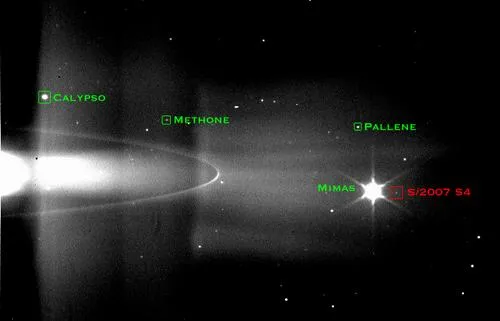
The new discovery first appeared as a faint dot in a series of images Cassini took of the planet's ring system on May 30 of this year. After the initial detection, Carl Murray, from the Cassini team, along with the other mission scientists, played planetary detectives searching for clues of the new moon in Cassini's voluminous image library.
In this way they located numerous additional detections, from June 2004 to June of this year. "With this new data we were able to establish a good orbit for the new moon," says Murray, and adds, "Knowing where the moons are at all times is important for the mission for many reasons."
One of the most important reasons is to avoid colliding with them. Furthermore, each new discovery helps in a better understanding of the ring system's interaction and how its countless parts function and interact together. Finally, the discovery of a new moon is important because with this knowledge, scientists can plan experiments during future observations.
For the moment, the new moon is called "Frank" or S/2007 S4. It is about 2 kilometers wide and is made mainly of ice and rock. The moon's location in the Saturnian sky is between the orbits of Methone and Pallene. It is the fifth moon discovered by the Cassini imaging team.
Murray and his colleagues might have the chance to explore this new moon. The spacecraft's trajectory will place it 11,700 kilometers away in December 2009.
Sources and related links
- Cassini press release
- Note on Physorg
- Moons of Our Solar System
- Note on The Planetary Society