Between 2003 and 2006, 82% of the graduates in Astronomy from the UNLP went to another country.
Mariano Méndez in the office of his house in the Netherlands.
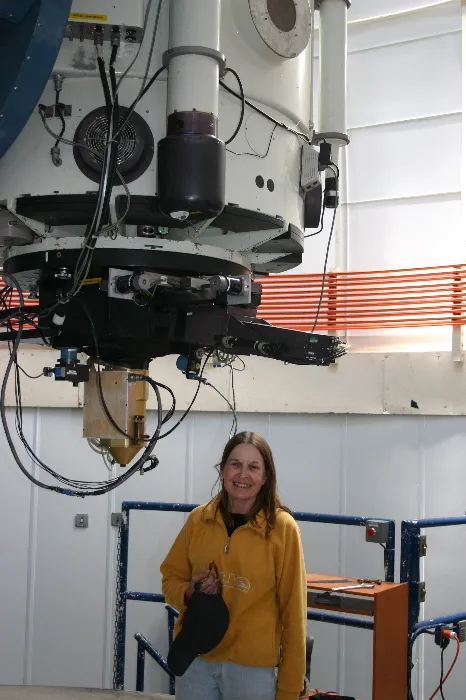
Since she arrived in Chile, at the end of 2002, Nidia Morrell has continued doing more or less what she did here: looking at the sky silently but tenaciously. Of course, hers is not a common gaze, but rather she studies massive stars and star-forming regions. "The same topic I was researching in La Plata," writes Nidia via email, and she specifies that, although she feels "nostalgia" for this city, she still doesn't think about coming back. "I take responsibility for being here because I chose it," she clarifies. And in that clarification perhaps the feeling of all the graduates in Astronomy from the UNLP who went abroad in recent years and did not return is summed up. Because Nidia's case is not an isolated case. It is one more link in the anonymous but long chain of astronomers who were trained under the chalk-colored dome of the Bosque and, once they graduated, went to look at the sky in another country.
Like Nidia, in recent years several graduates from the Faculty of Astronomical and Geophysical Sciences of the local University, whether to get their doctorate or to find new job horizons, decided to have their experience far from home. Of the 70 astronomers who graduated in the last decade, 11 went abroad to do their doctorate. But the data becomes significant if one considers that of those 11, nine did so between 2003 and 2006 (82%), "the maximum period of flight" according to the words of Pablo Cincotta, dean of that faculty.
Why do they leave? What do they research? How do they live? In principle, it is known that each story is a world apart. And in each world the answers change depending on who says them. Nidia's story abroad began when she decided to travel to Chile to go work at the Las Campanas observatory, located in La Serena and dependent on the prestigious Carnegie Institution of Washington. "I left with a two-year contract," she says, "but time passed and the people here made me feel at home, so I continue with life here and I think I'm going to stay."
In addition to analyzing star formations, Nidia also participates in the sophisticated Carnegie Supernova Project, a program that involves several astronomers from all over the world and is dedicated to observing two groups of supernovae: some in the nearby universe and others much farther away.
"With the study of nearby supernovae," explains Nidia, "the aim is to refine the methods that allow using these events for the precise determination of distances; which will then be applied to the other group for a cosmological analysis." Complicated or not, representable for the common gaze or simply incomprehensible, the truth is that this work implies long sleepless nights with eyes glued to the telescope.
"Most astronomers from the UNLP have international experience," points out Cincotta. "With the 2001 crisis, 13 percent of the researchers in training decided to do their doctorate outside the country, financed by the host institution. The return or not of these future researchers will depend, among other factors, on the opportunities offered by a country that for many decades has not had a state policy in science and technology."
What the dean explains about the academic level in La Plata is corroborated by the data managed by the UNLP itself: the Faculty of Astronomical and Geophysical Sciences of La Plata trains 90 percent of the country's astronomers. But it's not the only thing: because the students of this academic unit have the highest average per student of the La Plata faculties, since to obtain any scholarship it is essential that the recent graduate show an impeccable academic record (see from La Plata...).
For the authorities of the faculty, all these particularities explain "the level of excellence shown by researchers trained at the UNLP when they go to work abroad." And an example of this is the story of Mariano Méndez and Amina Helmi, a couple of astronomers from La Plata in their forties who for several years have been working at research centers in Europe. "In '95 the opportunity arose to come work at the University of Amsterdam," says Mariano. "What interested me at that time was the possibility of researching a topic that was not being investigated at the La Plata Observatory in those years: the observation of black holes."
During his stay in the Netherlands, Mariano worked with data from satellites that measure X-rays and studying the material that falls into black holes. "The experience in Amsterdam was excellent and my work was recognized internationally," says Mariano, who after that experience abroad returned with his wife Amina to Argentina.
"She is also an astronomer," he relates, "and she got her doctorate in the Netherlands during this same period. While in Argentina we were invited to work in Europe again. Me in the Netherlands and her in Germany. After thinking about it a lot we decided to give it a try. This time it was more difficult because we were separated by a thousand and something kilometers: she in Munich and I in Utrecht. It was hard, but we managed it quite well. We traveled to see each other every weekend; one weekend I went to Germany and the next she came to the Netherlands. Actually, this was possible because at that time we didn't have children, and luckily it only lasted a year and a half. After that time she received an offer to come work in the Netherlands and our lives normalized a bit."
With things more settled, for 7 years Mariano has been working at the Netherlands Institute for Space Research, where instruments that are later launched on satellites are built. "Being here I became responsible for an instrument that was built at our institute and that is used in the "Chandra" X-ray Observatory, a NASA satellite. Something similar to the Hubble Space Telescope, but in X-rays."
Brain drain. The term, recurrent when illustrating the exodus of Argentine scientists abroad, gains strength if one considers that currently there are about 7,000 scientists from our country conducting their research abroad.
The greatest exodus of scientists from our country occurred starting in 1966, when the military dictatorship known as the "Argentine Revolution" was established, led by then Lieutenant General Juan Carlos Onganía. Shortly after taking power, that government intervened in the universities in what became known as "The Night of the Long Batons." But the brain drain did not stop there, since, according to a study by the Economic Commission for Latin America and the Caribbean (ECLAC), Argentina was the Latin American country that contributed the most scientists and technicians to the United States in the 1990s.
According to the ECLAC research, out of every thousand Argentines who emigrated to the United States in the 1990s, 191 were specialized personnel. From Chile, 156 specialists emigrated per thousand emigrants, from Peru 100, and from Mexico 26, which shows that Argentina has "the highest supply of qualified human resources on the continent," according to the report.
Of course, international recognition, although fundamental and necessary, is never quite enough for Argentine scientists abroad to stop missing home or feeling somehow alienated from their new reality.
"Life abroad is difficult -Mariano acknowledges-. Although one has many satisfactions on the professional side, on the personal side it is often an uphill battle. The culture shock is very hard. I was born, grew up, and studied in La Plata. I played rugby at Los Tilos and in that way I met many people and built several social networks. When you insert yourself into a new environment, you have to start building those networks again. Even if you make new friends, there is no 'history' anymore. Also, in Argentina there is a lot of family support that you cannot bring with you to the Netherlands. And if here you want to visit a friend you first have to call them and plan the date and time in advance. Don't even think about dropping by someone's place unannounced."
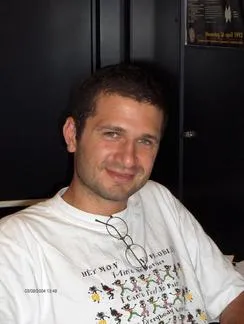
A panorama similar to the one Mariano describes is the one painted by Diego Altamirano, another astronomer from La Plata who, one month after graduating from UNLP, also went to work in the Netherlands. "Being here you learn to see the world with different eyes -he assures-. You learn to appreciate everything you didn't have, but the most notable thing is that you also learn to appreciate what you did have before and now no longer have."
Diego writes his own story via email: "One of my greatest dreams was to be able to travel the world and mainly get to know Europe, the continent of my grandparents. And well, it turned out that I studied Astronomy and became interested in a topic in which there are no experts in Argentina: X-ray data analysis to better understand what black holes and neutron stars are. If I wanted to delve into this topic, there were only two options. One was the United States and the other Europe. It's hard to say how the change was since everything happened very quickly. The thing was, I applied for several scholarships and did very well, to the point that one month after graduating I was already working in the Netherlands."
Trying for almost two years to understand what black holes and neutron stars are from X-ray observations, Diego feels that, although nostalgia weighs on him, a good part of his professional dream is fulfilled. Similar to what Nidia, Mariano, and his wife Amina feel. All astronomers who learned about the mysteries of galaxies at the Observatorio del Bosque and one day decided to use that learning in other lands. Speaking another language or learning new customs, but always with the fixed idea of understanding something more about the universe and with their eyes fixed on the sky. Always on the sky.
"I left to be respected"
"The idea of leaving the country I had since I finished high school. As the years passed, the idea became a necessity. At this moment I feel I cannot live there. Not because of economic problems but because of society. It is very difficult to work there. There is no respect for those who want to study or work. It could be said that I did not leave the country in search of a job, but in search of a society that fits my person."
The one who says this -via email- is Claudio Llinares, a 30-year-old astronomer from La Plata who on October 27 last year, one week after graduating, left the country to do his doctorate at the Institute of Astrophysics in Potsdam, Germany.
Trained in La Plata with one of the best averages, Claudio researches the origin of the structure of the universe through computer simulations. "The central theme of my thesis -he explains- is an application of cosmology to basic physics. We are trying to test a new gravitational theory that allows solving certain issues with which general relativity could have problems. I am also working on standard cosmology, trying to make an advance in determining the origin and characteristics of galaxy rotation."
When explaining the changes he found in his new society, Claudio does not hesitate: "It was not only in work but in daily life. This is a society where you don't have to look to see if a car is coming before crossing the street. It seems stupid but trivial things like that make life much more relaxed and allow you to live much better without having more money or anything like that."
Of course, the changes are also seen at work: "If for example you have a problem with the computer, instantly someone appears to fix it, and if you need a book and it's not in the library, you request it and the librarians get you the book no matter what. Another good thing about being here is that everything is very close and there are several schools and conferences where you can have contact with the best researchers in Europe."
From La Plata to the world
Despite budget crises, far from urban concentration and under the fresh, sweet aroma of the eucalyptus trees of the Bosque, the Observatorio de La Plata remains the cradle of Argentine astronomy. And it is not an opinion, but a fact supported by the rigor of numbers: according to the local University itself, the Faculty of Astronomical and Geophysical Sciences of La Plata trains 90 percent of the country's astronomers.
Between both degree programs, currently about 300 students study there and more than fifty professors work, who at the same time have the task of investigating the mysteries of the Milky Way and coordinating satellite geodesy work.
The work of those who work at the Observatory does not consist only of studying planets, stars and galaxies. Geodesy, for example, of which the local specialists are references throughout Latin America, allows determining the shape and dimensions of the Earth.
In Argentina, it must be said, there are barely three astronomy faculties (the other two are in San Juan and Córdoba) and just over 250 astronomers, in addition to the almost 50 specialists who these days represent our country abroad. As explained, the La Plata faculty is the one with the largest number of teachers and the highest academic profile, which in some way explains why 90 percent of Argentine astronomers are educated here.
But there is more, because the students of this academic unit have the highest average per student of the La Plata faculties. With a general average of 8.50, between 5 and 10 students graduate per year. It happens that, unlike the rest of the faculties, the student here not only strives to graduate, but to do so with a good average. To obtain a scholarship, in fact, it is essential that the recent graduate show an impeccable academic record.
For the authorities of the faculty, these particularities mean that "any La Plata graduate can perform very well abroad. Despite the budgetary drawbacks suffered, the La Plata Observatory continues to be a world-class reference."
And an example of this was given a few years ago by Adrián Brunini, a professor at the Faculty, and Mario Melita, a La Plata astronomer who works in England, who, in what represented a true worldwide discovery, raised the chance that a tenth planet exists within the solar system. This "new" planet, according to the local specialists, could be located at a distance equivalent to 60 times the distance between Earth and the Sun, and perhaps have a size similar to that of Earth.
Sources and related links
- Article in the newspaper El Día, By FACUNDO BAÑEZ
- Cielo Sur: "Curiosity and aesthetic pleasure is what attracts me to Astronomy", Nidia Morrell
- Neutron Stars Reinforce the Theory of Relativity, work by Mariano Méndez commented by Alejandra Sofía
- Amina Helmi's site
- Clarín: Two Argentine astronomers discovered a new planet, the tenth in the Solar System