The evidence to date is not conclusive, but astronomers say a relatively simple test could settle the matter: look for a pair of stars fleeing the galaxy at high speed.
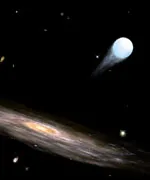
Illustration of a star fleeing at high speed from a black hole. Credit: Ruth Bazinet, CfA
Astronomers believe there is a colossal black hole—weighing about 3.6 million times more than the mass of the Sun—at the center of the Milky Way. But some argue there is a second black hole weighing between 1000 and 10000 suns.
The evidence comes from observations of a cluster of young stars located only a fraction of a light-year from the monstrous black hole, where gravitational forces should prevent the formation of any star. The cluster could have formed at a great distance and migrated, however, if it contains an intermediate black hole that was gravitationally dragged toward the galactic center.
But it has been impossible to prove the suggestion. Now, Lu and his colleagues say the case could be closed if astronomers find a pair of hypervelocity stars fleeing the dangerous region.
Three's a crowd
Since December 2004, ten of these speedy cosmic demons have been found. The first was clocked at 850 km per second, fast enough to eventually escape the galaxy entirely.
Astronomers think something very massive must be accelerating the stars and that the acceleration originates in the interaction among three objects, although which those objects are is still under debate.
In one scenario, a pair of stars wander very close to a supermassive black hole and one is captured while the other is flung out at high speed. In another scenario, a star approaches a pair of black holes and is ejected at high speed.
Now, Youjun Lu, an astrophysicist at the University of California in Santa Cruz, USA, and his colleagues say there is an observational test to distinguish between these two mechanisms.
Their calculations suggest that finding a pair of hypervelocity stars shot into space at 1000 km/sec or more could be "definitive evidence" of the existence of two large black holes in the Milky Way.
Sphere of influence
Due to their orbits around each other, two black holes would generate a larger sphere of influence in their surroundings than a single one. So if they were approached by a pair of stars that were very close to each other (less than one-third the distance between Earth and the Sun), they would treat the stellar pair as a single star and shoot them out at hypervelocities.
According to the scientist, this would not happen with a single black hole because it would treat the stellar pair individually, capturing one star and expelling the other.
"For a single black hole, the probability of ejecting a binary pair at hypervelocity is negligible," said the scientist.
Lu says that about 10% of the stars in the vicinity of the Sun have a close companion. So if that proportion is the same in the galactic center, one of the 10 hypervelocity stars already found could actually be a binary.
The stars are too far away to distinguish whether they are single or double. But their spectra should reveal if they wobble due to the gravitational pull of a close companion. The wobble should vary with the period of the stars around each other, which is expected to be from days to weeks.
Easy to test
Warren Brown, an astronomer at the Harvard-Smithsonian Center for Astrophysics (CfA), led a team that found eight of the 10 hypervelocity stars. He hopes to reobserve all of them to look for these signals.
"I think it's a prediction that is easy to test observationally," commented the scientist.
Lu says that finding a second black hole in the Milky Way would not only explain the young star cluster found there, but would also tangle up the standard theories of how galaxies grow.
It is thought that galaxies form through the merger of smaller galaxies or star clusters, each of which could contain its own black hole. Over time, the black holes approach and eventually also merge.
Brown agrees that our galaxy's supermassive black hole could have grown by merging with another in the past, but he believes the evidence points to a single black hole at the galactic center today.
"A single black hole seems to be the most likely scenario in my mind," he says. "But there is no evidence that a second black hole wasn't there 100 million years ago and merged and now we don't see it."
Sources and related links
- Note in NewScientist, by Maggie McKee
- Paper: Hypervelocity binary stars: smoking gun of massive binary black holes, Youjun Lu, Qingjuan Yu, D.N.C. Lin, ApJL in press
- Astroseti: Two stars headed for intergalactic exile