What happens when a star dies? Is the Universe expanding or contracting? New experiments are trying to answer big questions like these.
Members of the physics department at Florida State University (FSU) have begun using an innovative facility to conduct experiments that could help provide answers to those questions.
RESOLUT is the name of the facility, located on the FSU campus. RESOLUT comes from "REsonator SOLenoid with Upscale Transmission".
In recent months, researchers have been using RESOLUT to create short-lived radioactive particles, similar to those inside exploding stars. Data from the experiments are used as bases for hypotheses about the behavior of matter and the physical properties that govern the universe.
"We are doing experiments that replicate, in a controlled way, the explosions that occur in stars," says Ingo Wiedenhover, a professor at FSU and leader of the RESOLUT team. "This helps us understand the nuclear process that occurs in stars, the origin of the elements and how stars explode."
Getting to this point has been a hard process that began in 2002.
"After five years of proposals, fundraising, design, creation and careful testing, we are very happy that this is how we managed to get it online for experiments," says Samuel Tabor.
Weighing 16 tons, RESOLUT allows researchers to fire a beam of atomic particles through a steel tube at speeds approaching 60 million miles per hour - almost 10% of the speed of light - and then observe the nuclear reactions that occur.
"When the beam hits a target, the collision produces exotic nuclei that contain properties similar to those in stars and their explosions. But perhaps its greatest value as a scientific instrument is its function as a mass spectrometer, a device that allows identifying and studying the short-lived particles created during these miniature explosions," adds Wiedenhover.
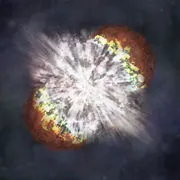
Wiedenhover is supervising several experiments that create, for a fraction of a second, a specific type of radioactive nucleus that is only found in a type of explosion known as a Type Ia Supernova.
"Type Ia supernovas result when a certain type of star known as a white dwarf reaches a critical mass and burns its nuclear fuel so fast that it suddenly explodes. What makes these explosions so useful for astrophysicists is that they always release the same amount of energy, so their peak brightness is virtually the same. This uniform level of brightness makes Type Ia supernovas useful as 'standard candles' for measuring distances across the universe."
"Now, with RESOLUT we hope to learn more about these gigantic nuclear explosions, safely in our laboratory."
Sources and related links
- Article on Physorg
- Press release at FSU