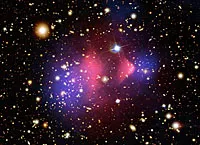
By combining the capabilities of several telescopes, astronomers have seen extremely bright galaxies hiding in the distant and young universe.
The galaxies found are intrinsically bright due to their high star formation rate - 1000 times greater than the Milky Way. However, much of that light is hidden by the surrounding gas and dust.
The galaxies are located about 12 billion light-years away and existed when the universe was less than 2 billion years old. They are the most luminous and massive galaxies seen in the distant universe. Smaller and fainter galaxies were much more common in the early universe because it takes time for galaxies to form and grow.
"It's a real surprise to find such massive and luminous galaxies existing so early in the universe," says astronomer Giovanni Fazio of the Harvard-Smithsonian Center for Astrophysics.
Initially, the galaxies were detected with the AzTEC camera on the James Clerk Maxwell Telescope. It was developed by a team led by Grant Wilson and Min Yun of the University of Massachusetts and discovered several hundred galaxies that were bright at millimeter and submillimeter wavelengths.
A team of astronomers conducted follow-up observations of seven bright galaxies in an area of the sky studied by the Cosmic Evolution Survey (COSMOS). The Smithsonian Submillimeter Array determined the exact location of each galaxy, allowing the team to confirm that the source was a single galaxy and not a combination of several fainter galaxies.
Once the locations were known, additional observations were made with the Hubble and Spitzer space telescopes, as well as with the Very Large Array (VLA) radio telescopes. Even Hubble's powerful vision could not detect them, confirming that they are surrounded by dust that blocks visible light. Spitzer, on the other hand, could penetrate the dust with its infrared vision. The VLA could only detect the two closest ones.
By combining these measurements, astronomers showed that five of the seven galaxies have a redshift greater than 3, which corresponds to a distance of 12 billion light-years.
The great infrared brightness indicates they are forming new stars rapidly, probably due to collisions and mergers.
"The source of the infrared radiation appears to be very compact, suggesting they are colliding galaxies that will eventually evolve into quasars," said Younger.
The results will be published in Astrophysical Journal and are available online.
About the image
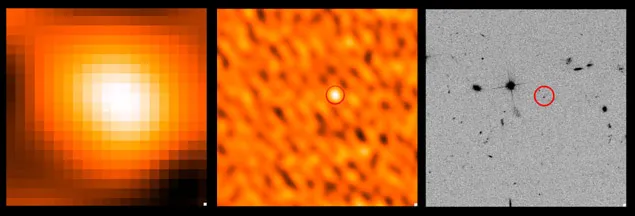
The AzTEC submillimeter camera detected this bright source (Left) in a region of the sky studied by COSMOS. The high resolution of the Smithsonian Submillimeter Array determined the radiation source (center). A visible-light image from Hubble (right) only shows a faint spot that is barely detectable.
Credits: Left – UMass Amherst / Center – Harvard-Smithsonian CfA / Right – COSMOS/ACS Team
Sources and related links
- CfA press release
- Paper: Evidence for a Population of High-Redshift Submillimeter Galaxies from Interferometric Imaging