Listening to the Comet's Song, the sounds that arise from a pulsar or a quasar, the orchestra of the Cosmos, is possible.
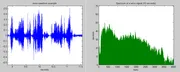
Wikimedia:Example of a voice waveform and its frequency spectrum
Sound waves cannot travel in empty space. But electromagnetic waves can. The latter can be recorded by devices called spectrographs in many of the large telescopes.
On this website, the author converted those electromagnetic waves into sound waves. To do this, he reduced the frequency since the original ones are too high for the human ear.
This allows us to hear the sound of the universe:
Journey to the Center of a Quasar (1.3mb): In this clip, we travel to the violent heart of a galaxy. We begin flying through the galaxy's outer regions (hissing sound) passing several stars (different high-pitched whistles) before penetrating the great cloud around the black hole hidden at the center. We penetrate different parts of the cloud, constantly moving closer and closer to the black hole, before hearing the roar of gas falling toward the event horizon.
Sounds of Nebulae (864kb):Mix of sounds from different nebulae
The celestial orchestra explained (1.6Mb): The author shows how the different instruments of the celestial orchestra (the different chemical elements) create the sound of a nebula, the Eskimo Nebula NGC2392
Planetary Nebula:Film and sounds (1mb): A Quicktime film combining images of five planetary nebulae (taken with Hubble) with the detected sounds.
The comet's song (664kb): Listen to a comet approaching the Sun. The sound is due to molecules, leaving the comet's surface due to the Sun's heat.
The life of our Sun (1mb): The complete life of a star like our Sun, compressed into two minutes.
Sources and related links
- Sounds of the Universe
- ESA:Sounds of Titan
- Sounds of the Big Bang
- Sounds of the universe
- Sounds of a black hole
- Frequency spectrum