These images of two supernova remnants, G347.3-0.5 and RCW 86, show the result of combining data from NASA's Chandra and ESA's XMM-Newton observatories. In each image, XMM obtained data from a wider field of view, while Chandra has been used to focus on key areas of interest for the researchers. (Outlined in the areas).
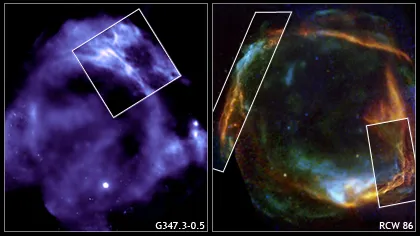
RCW 89 (Right panel) is perhaps one of the earliest stellar explosions ever detected. The formation of the remnant seems to coincide with the supernova observed by Chinese (and perhaps Roman) astronomers in 185 AD. Together, Chandra and XMM show the expansive ring of debris that was created after a massive star in the Milky Way collapsed and exploded. Low-energy X-rays are seen in red, medium-energy in green, and high-energy in blue. Chandra's observations focused on the northeast and southwest of RCW 89 and show that the radiation is produced by high-energy electrons accelerated in a magnetic field (blue) as well as the heat from the explosion itself (red).
As in the case of RCW 89, it is believed that the Chinese could have witnessed the supernova that caused G347.3-0.5, but a couple of centuries later, in 393 AD. According to Chinese records, a bright star in the location of G347.3-0.5 was visible for months and rivaled the brightness of Jupiter. The X-rays from G347.3-0.5 are dominated by radiation from extremely high-energy electrons. The remnant is also a source of high-energy gamma rays. The bright source in the lower section of the image (which only shows the upper portion of the remnant) is similar to other known neutron stars and indicates that G347.3-0.5 is the result of the collapse of the core of a massive star. In both Chandra and XMM-Newton images, the intensity of the X-rays is represented by the brightness of the colors.