Get your calendar ready. The most spectacular meteor shower of the year is approaching: the Perseids.
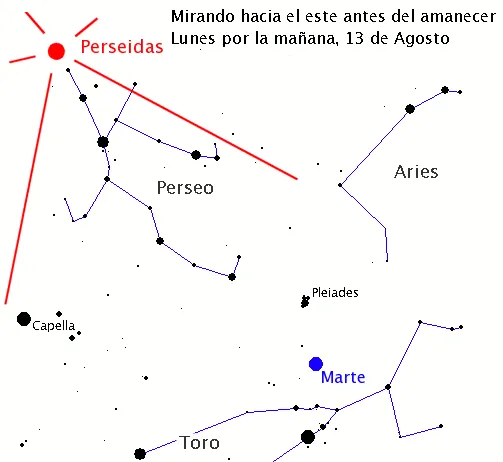
The eastern sky seen during the hours before sunrise, on Monday, August 13, 2007.
Do you have a calendar? Mark this day: Sunday, August 12. Next to the mark write "all night" and "Meteors!". Put it in a visible spot on your refrigerator so you don't miss the 2007 Perseid meteor shower.
"It's going to be a great show," says Bill Cooke, of NASA's Meteoroid Environment Office, at the Marshall Space Flight Center. "We'll have a new moon on August 12 —which means there will be no moonlight, so we'll have dark skies and lots of meteors." How many? Cooke estimates one or two Perseids per minute during the shower's peak.
This meteor shower originates from Comet Swift-Tuttle. Although the comet is not near Earth, its tail intersects Earth's orbit. We pass through it every year in August. Small fragments of dust from the comet then collide with Earth's atmosphere at 212,000 km/h (132,000 mph). At this speed, even the tiniest speck of dust produces a vivid luminous streak —a meteor— as it disintegrates. Because the meteors from Comet Swift-Tuttle appear to come from the constellation Perseus, this meteor shower is called the "Perseids."
Note: In the following account, all times mentioned are local time. For example, 9:00 pm means 9:00 pm in your time zone.
The show will begin between 9:00 and 10:00 pm on Sunday, August 12, when the constellation Perseus rises in the northeast. This is the time to look for Perseid meteors that approach from the horizon and graze the atmosphere like skipping stones on the surface of a lake.
"Earth-grazing meteor trails are long, slow, and colorful; and they are one of the most beautiful kinds of meteors," says Cooke. He cautions that in an hour of observing you might see only a few —"at most"— but seeing at least one makes a long night of waiting worthwhile.
As the night progresses, Perseus climbs higher and the number of meteors increases greatly. "Starting at 2:00 am on Monday, August 13, dozens of Perseids can appear crossing the sky every hour." The climax occurs just before dawn, when the meteor rate can be more than one per minute.
For best results, advises Cooke, "get away from city lights." The brightest Perseids can be seen from cities, he says, but the most spectacular bursts, composed of faint and delicate meteors, will only be visible in rural areas. Explorers, this is a good opportunity to camp.
And there will be something extra: Mars. In the constellation Taurus, just below Perseus, Mars will look like a bright red star. Many of the Perseids you observe on August 12 and 13 will pass very close to it. Instead of watching the meteor's path, you might find it hard to look away from Mars. There's something captivating about it, maybe the red color, or perhaps the fact that it doesn't twinkle like real stars do. You stare at Mars, and it stares back.
Earth and Mars will experience a close encounter in December 2007. NASA is taking advantage of this, and will do so by sending a new mission to Mars —the Phoenix Mars Lander. Phoenix will land on an arctic plain where it can dig into the surface and investigate layers of soil and also ice, searching, among other things, for a habitable zone for primitive microbes. The launch window opens on August 3, so by the time the Perseids arrive, the Phoenix lander will already have been launched toward the Red Planet. Its scheduled arrival on the Martian surface: late spring 2008.
This is something to think about at four in the morning, with Mars rising in the East, meteors crossing the sky, and a summer breeze making your pajama legs whisper.
Maybe you should go mark your calendar again.
Sources and related links
- Ciencia@NASA: The Great Perseids
- Wikipedia:Appendix:List of meteor showers