NASA astronomers are preparing to observe the lunar eclipse, but not only for its beauty, but for the possibility of seeing meteoroids collide with the Moon.
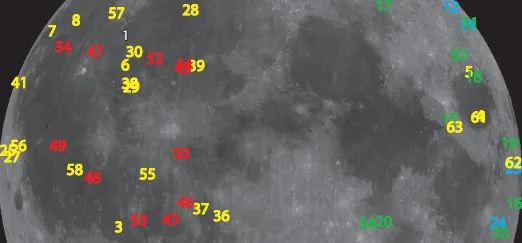
A lunar map showing the sites where the MEO has observed meteoroid impacts since December 2005. NASA.
Most people appreciate lunar eclipses for their silent beauty in the middle of the night. But Bill Cooke, the NASA astronomer, watches them for a different reason: he loves explosions.
In the early hours of Tuesday, August 28, the shadow of planet Earth will cover the face of the Moon in what will be a lunar eclipse lasting an hour and a half. In that darkness, Cooke hopes to record some flashes of light—explosions caused by meteoroids that collide with the Moon and explode into dust.
"This eclipse is a magnificent opportunity to observe," says Cooke, who heads the Meteoroid Environment Office (MEO, in English), at the Marshall Space Flight Center. The entire face of the Moon will be in shadow for more than two hours, thus offering 23 million square kilometers of dark terrain as a target for meteoroids.
Lunar explosions are nothing new. Cooke's team has been monitoring the Moon since late 2005 and has recorded, so far, 62 impacts. "Meteoroids that hit Earth disintegrate in the atmosphere, producing a harmless luminous trail. But the Moon has no atmosphere, so 'lunar meteors' always collide with the surface," he says. Typical collisions release energy equivalent to 100 kg of dynamite, and excavate craters several meters wide, while producing bursts of light bright enough to be seen from a distance of 362,000 kilometers, on Earth, through common telescopes.
"About half of the impacts we see originate from common meteor showers, like the Perseidas and the Leónidas," says Danielle Moser, a member of the MEO team. "The other half are caused by 'sporadic' meteoroids that are not associated with any particular comet or asteroid."
The MEO observatory is located on the grounds of the Marshall Space Flight Center in Huntsville, Alabama, and has two 14-inch telescopes equipped with video cameras especially sensitive under low-light conditions. Moser and her colleague Victoria Coffey will be working at the observatory on Tuesday morning.
During the eclipse, they hope to capture on video an elusive type of meteoroide, called a Helion.
"Helion meteoroids come from the direction of the Sun," says Cooke, "and that makes them especially difficult to observe." They cross the sky usually around noon, when the dazzling brightness of the Sun is too intense to distinguish meteors.
Wait a minute. Meteors coming from the Sun? "The Sun itself is not the source," explains Cooke. "We believe Helion meteoroids come from comets that grazed the Sun and left trails of dusty debris in the vicinity of our star."
No one can be sure, however, because Helion meteoroids are devilishly difficult to study. Astronomers only see them in very small numbers, just before dawn or after dusk. Attempts to observe Helion meteors by radar during the day have failed, to some extent, due to interference from terrestrial radio transmissions and solar radio bursts, which overpower the acoustic signals or "pings" from meteors.
The eclipse:
During the eclipse, the Man in the Moon (the "face" or figure seen on our satellite from Earth) will be facing the Sun—"thus creating the perfect geometry to intercept Helion meteors," says Moser. "And with Earth's shadow providing the required darkness, we should be able to clearly see any explosion."
"If we manage to capture Helion meteoroids hitting the Moon and study their flashes, we will learn more about their size, speed, and penetration," she adds. That, in turn, will bring the MEO closer to its goal of calculating the meteoroid occurrence risk for spacecraft and future astronauts walking on the Moon.
No one has ever seen a lunar impact during an eclipse, "but there's always a first time for everything," says Cooke. Stay tuned to Ciencia@NASA for the results.
Sources and related links
Note on Ciencia@NASA