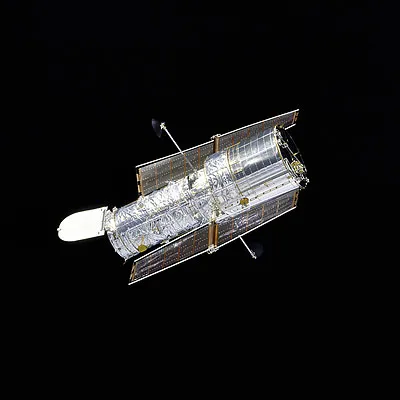
The Hubble Space Telescope has photographed three magnificent sections of the Veil Nebula - the shattered remains of a supernova that exploded 5000 or 1000 years ago.
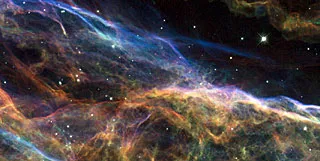
The Veil Nebula is a prototypical supernova remnant and is an ideal laboratory for studying the physics of these explosion remnants. It is quite close and has a large angular size. The nebula is also known as Cygnus Loop and is located in the constellation Cygnus, the swan. It is about 1500 light-years from Earth. One of the most notable regions is the so-called Witch’s Broom Nebula. The bright blue star, called 52 Cygni and unrelated to the supernova explosion, can be observed with the naked eye on a clear summer night.
The images were taken with Hubble's Wide Field and Planetary Camera 2 (WFPC2). The color is produced by a composition of three different images. They indicate emission from different types of atoms excited by the shock: blue shows oxygen, green shows sulfur, and red shows hydrogen.
Sources and related links
The Veil Nebula is also known as: Cygnus Loop, NGC 6992, NGC 6995, NGC 6960, Cirrus Nebula, LBN 191
Photo Release - heic0712: Uncovering the Veil Nebula