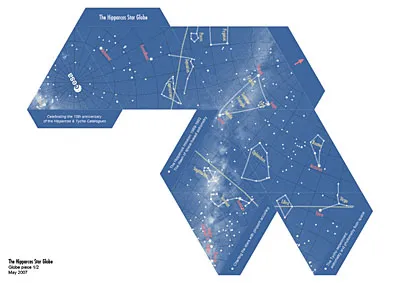
ESA's Hipparcos satellite mapped our galaxy and discovered millions of stars. With the information collected, it is now possible to make our own Milky Way globe and even our own brochure.
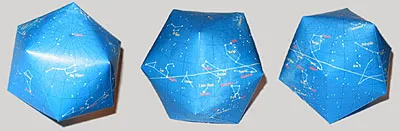
This is how the Hipparcos Galaxy Globe looks
You need to get a little glue, a pair of scissors, print the two following pages (in pdf) and we are ready to make our galaxy globe.

Download the instructions (PDF of 1936 kb)
And to make the brochure:
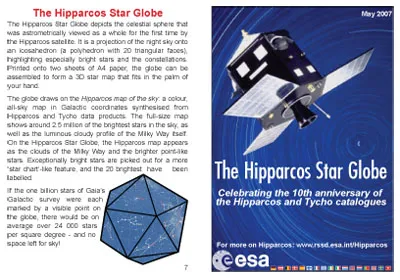
And the instructions, here.
And why this galaxy globe? To celebrate the 10 years of Hipparcos and Tycho.
Ten years have passed since the launch of the Hipparcos and Tycho catalogs, the first produced from observations in space. Since then, Hipparcos has been reprocessed to become the best map of our galaxy.
Hipparcos comes from High Precision Parallax Collecting Satellite. The satellite was launched in 1989. Designed to determine the position and distance of more than 100,000 stars (hence the Parallax, parallax) with a precision that surpasses ground observations by a factor of 10 to 100. The catalog contains about 120,000 stars. Tycho was an unplanned product of the mission and is larger, of one million stars.
To be more precise, Hipparcos contains information on 118,218 stars, most of which (97%) are also classified in Tycho. It contains astrometric information, of motion and location and a photometric color. Tycho has two photometric colors but less astrometric precision for more than one million stars. In 2000, with the data, Tycho-2 was compiled with 2.5 million stars.
Due to the limitations of the computational models used to process the data obtained years ago, it was not possible to incorporate some of the effects of micrometeoroids on the observations. The movement of the solar panels relative to the spacecraft, although small, also introduces some subtle errors.
Now, with better technology, a task that used to take 6 months 20 years ago, can be done in a week on a desktop computer. The models have been refined and run again, revealing much more.
The printed version of the catalog is released in the book 'Hipparcos, the new reduction of the raw data'. The data from the new realization will be available online early next year.
The result is an improvement by a factor of 2 over the original. Even more notable improvements were obtained in specific cases such as the distances of open clusters (2 to 3 times more precise), better parallax for the Cepheids led to a better estimate of the Large Magellanic Cloud.
Sources and related links
- Note on ESA
- ESA:10 years of Hipparcos and Tycho
- Hipparcos