A new study suggests that the two known classes of magnetic cataclysmic variable stars would be an evolution from one class to the other. The study may have found an intermediate system to support this idea.
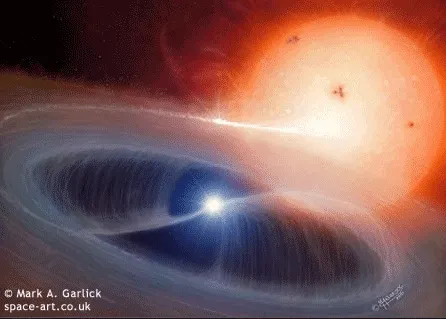
Illustration. Copyright M.A. Garlick.
An international team of astronomers may have discovered the missing link in the evolution of so-called variable stars cataclysmic. The scientists determined the spin and orbital periods of the binary Paloma. They found that the system has a rare form of rotation that would fill the gap between two classes of cataclysmic stars. Their results will be published in Astronomy & Astrophysics.
Cataclysmic variables (CVs) are a class of binary stars composed of a white dwarf and a normal star, like our Sun. Both orbit so close to each other that the dwarf accretes material from its companion. In the vast majority of known CVs, the material orbits around the dwarf forming a disk before being accreted and incorporated into the star. About 20% of known CVs include a white dwarf with a powerful magnetic field (of several million Gauss). These stars are known as magnetic cataclysmic variables. The dwarf's magnetic field can be powerful enough to break the accretion disk or even prevent its formation.
Astronomers currently know two classes of magnetic CVs:
Polars (or AM Herculis stars)
: have a magnetic field powerful enough to synchronize the spin period of the stars and the orbital period of the system. A deviation from synchronization is observed in four AM Herculis stars, presumably due to some recent nova explosion in those systems. The degree of asynchronism is less than 2%.
Intermediate polars (or DQ Herculis stars)
: have a weaker magnetic field and the spin period of the stars is less than the orbital period. Most DQ Herculis stars have orbital periods greater than three hours and spin periods between 33 seconds and one hour.
In a cataclysmic variable system, both stars are so close (the entire system would be the size of our Sun) that astronomers cannot distinguish one star from the other. To study them, indirect observations are used, such as measuring the variation in the system's brightness to estimate its characteristics.
Dr. R. Schwarz and his colleagues studied the candidate magnetic CV Paloma (known as RX J0524+42), which has not yet been characterized. It would not fit into either of the two known CV classes. The team presents both short- and long-term monitoring of the system using several European telescopes from 1995 to 2001. With this monitoring, they created the light curves and estimated the system's periods. ROSAT observations of the system confirm that it has a powerful magnetic field, so it belongs to the magnetic CVs.
From their observations, the team concludes that the fast white dwarf performs 14 spins around its own axis during 13 orbital revolutions. The rare degree of synchronization of the system makes it interesting, as the spin is much less than any known intermediate polar but is much more desynchronized to be an AM Herculis star. Paloma revives the old idea that both classes are linked by evolution and that intermediate polars are the ancestors of old AM Herculis stars. Theorists predict that Paloma is in the process of synchronization and will become an AM Herculis star in the next 100 million years.
Sources and related links
- Note on EurekAlert
- Paper:“Paloma (RXJ0524+42): the missing link in magnetic CV evolution?”, by Schwarz et al; published in Astronomy & Astrophysics, volume 473-2, p. 511