Using NASA's Swift and RXTE satellites, astronomers have discovered one of the rarest planetary-mass objects ever seen.
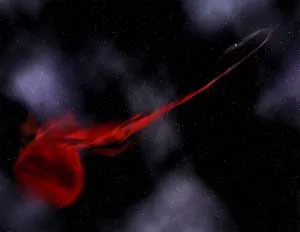
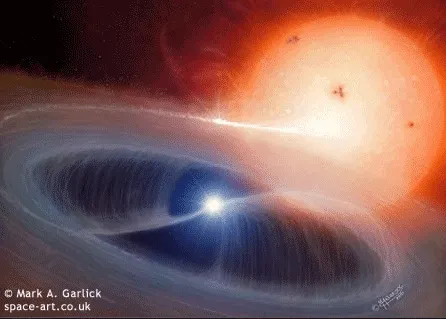
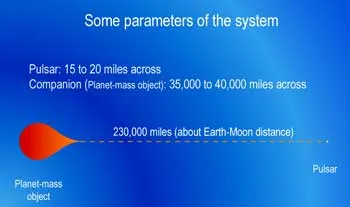
Illustration of SWIFT J1756.9-2508. Credit: Aurore Simonnet/Sonoma State University
The object is only 7 times the mass of Jupiter. And instead of orbiting a normal star, this low-mass body orbits a pulsar, every 54.7 minutes at an average distance of only 230 thousand miles (a little less than the Earth-Moon distance).
"This object is merely the skeleton of a star," says co-discoverer Craig Markwardt of the Goddard Space Flight Center. "The pulsar has eaten the star's outer layer and all that remains is the helium core."
Hans Krimm of Goddard discovered the system on June 7, when Swift's Burst Alert Telescope detected an outburst of X-rays and gamma rays toward the galactic center. The source was named SWIFT J1756.9-2508 for its coordinates in the sky, in the constellation Sagittarius.
RXTE began observing the source on June 13. From analyzing its data, Markwardt realized the object was pulsing in X-rays 182.07 times per second, meaning it is a pulsar. Subtle modulations in the pulsations were detected in the data, revealing a low-mass companion. Calculations show the companion has a minimum mass of 7 times Jupiter's mass. The system is the eighth observed pulsar accreting material from a companion. Only one other system has similar characteristics.
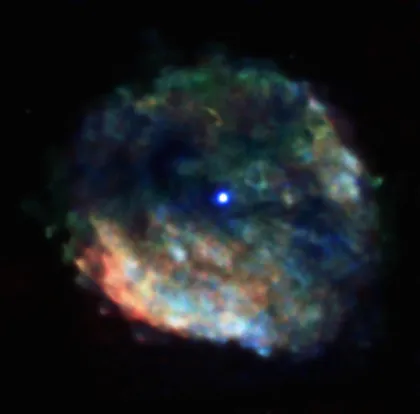
The system probably formed several billion years ago, with a very massive star and a smaller companion, of 1 to 3 solar masses. The more massive one evolved rapidly and exploded as a supernova, leaving a neutron star. The smaller one would eventually be on its way to becoming a red giant and the two objects became enveloped in the extensive stellar envelope, which eventually brought the objects closer together.
Currently, the two objects are so close to each other that the neutron star, with its great gravitational power, pulls on its companion, diverting gas that flows into a disk surrounding the neutron star. The flow becomes unstable and dumps large amounts of gas onto the neutron star, causing an outburst like the one observed in June.
Evolutionary models by Christopher Deloye suggest the low-mass companion is dominated by helium. "Although it is of very low mass, the companion is not considered a planet due to its formation. It is essentially a white dwarf that has been reduced to a planetary-mass object."
With an estimated distance of about 25 thousand light-years, the system is normally too faint to be detected at any wavelength and is only visible during an outburst. SWIFT J1756.9 had not been detected until June, so, as Markwardt says, "we don't know how long it will be until it wakes up again."