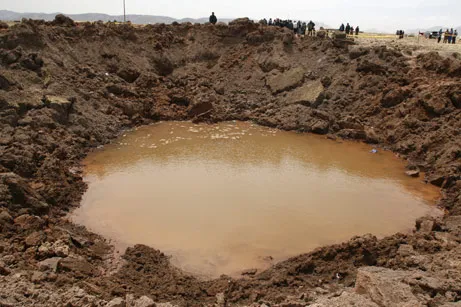
Every now and then a space rock grabs the media's attention. Threatening asteroids that speed by almost grazing the Earth, fireballs in the sky seen by hundreds of people, and mysterious craters that may have been caused by a meteorite impact are just a few examples of issues that give the ESA the opportunity to solve through possible missions, such as the Don Quijote project, which is currently under study.
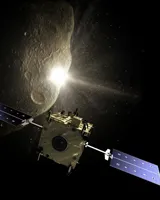
Illustration of Don Quijote. ESA
The uncertainty surrounding whether a meteorite has recently impacted South America shows the importance of knowing more about these natural 'space debris' and their trajectories. The ESA has always shown interest in helping to cover this need and has carried out a series of studies on how to do it.
These works suggest that, for now, it is probably the small rock fragments, specifically those up to a few hundred meters in diameter, that should concern us the most. Most of the large objects, over a kilometer in diameter, are currently being cataloged by a worldwide network of astronomers. There is also a project underway in which several ground-based telescopes 'sweep' the sky with the goal of detecting, before the year 2020, up to 90% of near-Earth objects larger than 140 meters. Only then will we know if space telescopes will be necessary to find the smaller objects.
Part of the problem with these small pieces of rock is determining their orbit. From Earth it is very difficult, sometimes even impossible, to determine their trajectory with enough precision to rule out a possible impact against our planet in the future. For now, the ESA has focused on a mission capable of both 'targeting' small asteroids and assessing the state of currently available technology. The Don Quijote mission study shows a two-phase project. In the first, a satellite will rendezvous with an asteroid and go into orbit around it, monitoring its position, shape, mass, and gravitational field for several months.
During the second stage, another satellite will impact the asteroid at a speed of about 10 kilometers per second. Meanwhile, the first satellite will observe any change in the asteroid's trajectory. It will be the first time an asteroid is actually moved thanks to the two satellites.
Don Quijote is a study for a possible small mission for small asteroids. As currently designed, the first satellite, called 'Sancho,' could reach any of the 5 or 6 nearby small asteroids. All of them measure less than a few hundred meters in diameter. For now, the project managers have decided to focus on Apophis, a small asteroid that could come dangerously close to Earth in one of its orbits around the Sun.
If it becomes a reality, the Don Quijote mission could be launched at the beginning of the next decade. Sancho would take about 25 months to reach its destination. Once there, it would begin its groundbreaking research—both literally and metaphorically.
"The goal is for the technology to be ready before we really need it," says Ian Carnelli, ESA Technical Officer responsible for the Don Quijote mission study.
In 1908, a 20-meter asteroid impacted the Tunguska forest in Siberia, leveling 2000 square kilometers of uninhabited land. Scientists estimate these events occur approximately every 150 years. Next year will mark 100 years since this impact; an anniversary that will remind us once again that we need to know more about asteroids to defend ourselves from them, even the smallest ones.
Sources and related links
ESA press release