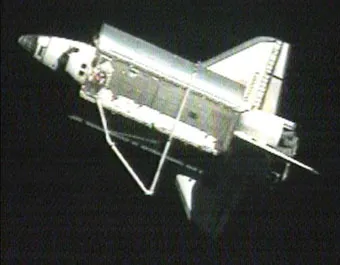
NASA scientists were studying this Tuesday the damage to the solar array panel of the International Space Station that broke while being repositioned by the crew of the Discovery.
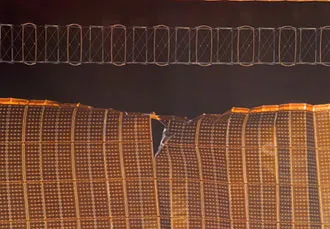
A view of the damage on the P6 4B solar array. NASA.
The tip of one of the 31 panels of the solar array was torn off just as the operation to reinstall it was almost completed, as shown by television images broadcast by NASA.
The double-winged array, with a 76-meter wingspan, began to be deployed shortly after a segment called P6, to which it is attached, was installed.
Suffredini estimated the tear was about 90 cm, but said the solar array was providing almost 97% of the power the space station needs.
"So we have plenty of time to solve the problem, we are following the sun, which means we have a very good configuration in terms of capacity to solve the problem," he added.
NASA took a series of photos to be able to assess the extent of the damage and examine the path forward to repair it.
The external cables that hold the panels together apparently are not damaged.
This solar array, the third one on the ISS, has become absolutely necessary to avoid postponing the transfer of the European Columbus laboratory, scheduled for early December. Even more so when a problem in the rotation mechanism affects another array on the station, installed just four months ago.
The ISS will be needing more electrical power for a space laboratory to be delivered in December and a Japanese one to be installed in 2008.
The mishap with the array occurred after astronauts Scott Parazynskiy and Doug Wheelock finished installing the P6 truss with the help of robotic arms operated by colleagues aboard the spacecraft and the ISS, culminating three days of work.
The spacewalk, the third of five planned, lasted seven hours and eight minutes.
The giant 16-ton metal truss, necessary to deploy the solar array, had been stored on the space station for seven years.
Earlier NASA confirmed it would extend the Discovery mission by one day to allow a closer inspection of the imperfections in the rotary joints that carry the solar arrays toward the space station.
In the fourth spacewalk planned for Thursday, the astronauts will examine the rotary joint after having found metal shavings during Sunday's spacewalk.
The inspection will require a spacewalk of more than six hours while the Discovery remains docked to the ISS. Because of all this, Discovery is expected to return to Earth on November 7, instead of the 6th.
It is planned that the ISS, a giant space laboratory orbiting 390 km from Earth, will become a potential starting point for further exploration of the solar system.
The $100 billion space station, funded by 16 countries, is considered key to U.S. ambitions to send a manned mission to Mars, and is estimated to be completed in three years.
The current mission is entering the history of space exploration as the commander of the spacecraft Pam Melroy, 46, and Peggy Whitson, 47, are the first women to hold command in the two orbital vehicles—Discovery and ISS—at the same time.
The Discovery will be retired in 2010. Its place will be taken by Constellation, a new space exploration project that seeks to put man back on the Moon by 2020.
Sources and related links
- Space Station at NASA
- Note at AFP