Two galaxies interact in an intricate dance in this new image from the Hubble Space Telescope.
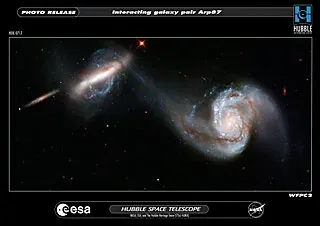
Arp 87. NASA, ESA, and The Hubble Heritage Team (STScI/AURA)
A pair of galaxies, known as Arp 87, is one of the hundreds of interacting and merging galaxies known in the nearby Universe. Arp 87 was cataloged by astronomer Halton Arp in the 1960s. The Arp Atlas of Peculiar Galaxies is a compilation of astronomical photographs taken with the Hale and Oschin telescopes at Mount Palomar.
The resolution in Hubble's images shows the galaxies with a much greater level of detail than when the galaxies were cataloged.
The two main members of Arp 87 are NGC 3808 on the right (the larger of the two galaxies) and its companion NGC 3808A on the left. NGC 3808 is a nearby galaxy with a bright ring of star formation and several prominent dust arms. Stars, gas, and dust flow from NGC 3808, forming an envelope around its companion. NGC 3808A is a spiral galaxy surrounded by a rotating ring containing stars and interstellar gas clouds. The ring is situated perpendicular to the plane of the host galaxy's disk and is called a "polar ring."
The shape of the galaxies has been distorted by their gravitational interaction with each other.
Interacting galaxies often exhibit high rates of star formation. Many lines of evidence—colors of the light, intensity of gas emission, infrared emission from heated gas—support this fact. Some mergers have the highest levels of star formation that can be found in the nearby Universe.
An important aspect of this excess formation could be revealed by Hubble's sharp gaze. Among the Observatory's early discoveries was that galaxies with very active star formation contain a large number of super star clusters—clusters more compact and rich in young stars than astronomers were used to seeing in our galactic neighborhood.
Arp 87 is in the constellation of Leo, approximately 300 million light-years from Earth. These observations were taken in February 2007 with the Wide Field Planetary Camera 2. Light isolated from blue, green, red, and infrared was combined to form this colorful image.
Sources and related links
- Note on SpaceTelescope
- Note on HubbleSite
- Note on ESA