Fifty years ago, a lively dog named Laika, taken from the streets of Moscow, became the first animal to break the Earth's atmosphere and enter space.
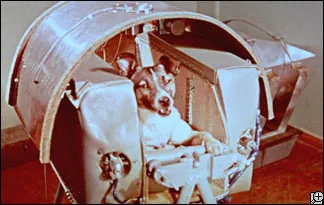
It was a short and painful journey for the little one, who died a few hours after launch but a supreme blow for the Soviet Union.
Only a month before, Moscow humiliated the United States by raising Sputnik into its orbit.
Beyond the propaganda value, Laika's small journey in her pressurized capsule also proved that a mammal can withstand the rigors of launch and paved the way for future Russian and American missions.
The dog's real name was "Kudryavka," or "Curly," as the scientists who trained her had named her, but fame would know her as Laika, the barker, the name given to Siberian hunting dogs.
On a Sunday, November 3, 1957 at 10:28 pm, Laika took off on her one-way trip looking at the camera and dressed in a space suit with sensors that monitored her heartbeat, blood pressure and breathing.
The official version of her fate is that Laika completed her mission 1600 kilometers above Earth and died peacefully, as planned, after a last meal with a powerful poison.
But rumors circulated, suggesting that she had simply run out of oxygen.
The truth emerged at a conference in the United States in 2002.
Dimitry Malachenkov, a scientist from the Biomedical Institute of Moscow who worked on the Sputnik 2 mission, revealed that the dog died from shock and exhaustive heat just hours after takeoff.
Terrified by the roar and vibration of the engines, the dog shook desperately to free herself as the rocket gained altitude and her heart raced three times faster than normal.
Then she calmed down as the capsule settled into its orbit but it didn't last long. A heat shield had been partially removed during separation and within a few hours the temperature inside the capsule reached 41 degrees Celsius.
Five hours after takeoff, Laika showed no vital signs.
Less than four years later, the door to the exploration of the cosmos opened to humans when Yuri Gagarin became the first human to reach space on April 12, 1961.
Four decades after the flight, the Russians dedicated a monument to her at the Institute for Aviation and Space Medicine near Moscow, where she and two other dogs were trained.