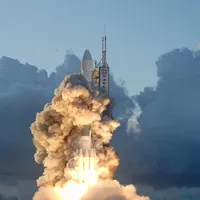
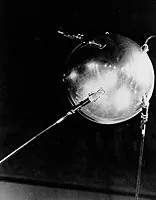
Fifty years ago, on a day like today, on the night of October 4, the first Beep-Beep from Sputnik reached Earth from space, beginning a new era for mankind.
Satellites and space probes have radically changed our way of life, they have turned the planet into a global city, where incalculable information is at our fingertips anywhere at any time. The planet has become smaller and our perception of it has also changed. Thanks to remote sensing and Earth observation, we can now better understand our environment and develop strategies based on the best knowledge of the evolution of our world.
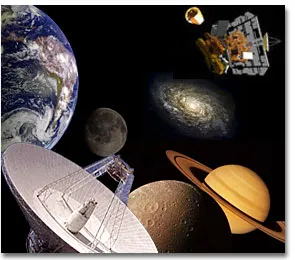
We have explored many planets in the Solar System, and our instruments installed in space have helped discover remote areas of the universe. What seemed a quiet sky has turned out to be a violent and active space.
Men and women have successfully carried out explorations of another world. They have settled in space and have begun to work from there. At first competing with each other and currently with a global spirit of cooperation and in search of peace and the benefit of humanity.
On Earth, engineers, scientists, technicians and even politicians and sometimes dreamers have worked together to turn dreams into reality, changing our lives forever and we hope for the better.
Europe's contribution to this great adventure has always been very significant, although at times it was little known or completely unknown to the general public. The vast majority of the great concepts that have led to the development of space technology and its subsequent applications have taken place in Europe, from rocket development to geostationary orbit. European scientists have been involved in the vast majority of the successes of these last five decades.
Halfway to the first centenary of the conquest of space, the year 2007 gathers the results of years of investment and engineering feats both under a European label and in collaboration with the United States and Russia.
Since the beginning of the year, ESA has been looking at the achievements obtained by those key people in space and describing the vast majority of advances they have been able to achieve in space science and technology, as well as access to Earth observation, and the exploration of planets and the deep universe.
Through this website, you can find most of those pioneers of the past and present.
Sources and related links
- Note at ESA
- ESA special
- Think Space Exploration Is Exciting Now? Wait Until You See What’s Coming
http://www.iqsdirectory.com/blog/think-space-exploration-exciting-now-wait-see-whats-coming/