A planet like Earth may be forming 424 light-years away in the stellar system HD 113766, astronomers say.
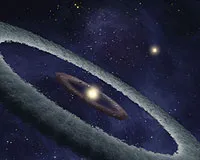
Illustration. NASA/JPL-Caltech/C. Lisse (Johns Hopkins University Applied Physics Laboratory)
Scientists found an enormous belt of dust -enough to form a planet like Mars or larger- spinning around a distant star that is only a little more massive than our Sun. The dust belt is located in the middle of the habitable zone of the system. This is the region around a star where water can exist on a rocky planet that can form. Earth is located in the middle of the habitable zone of our Sun.
About 10 million years old, the star is at just the right age to form rocky planets.
"The timing for this system to form an Earth is very good," says Dr. Carey Lisse of Johns Hopkins University. "If the system is too young, its planet-forming disk would be full of gas and would form gaseous giant planets like Jupiter. If the system is too old, the dust aggregation would have already occurred and the rocky planets would already have formed."
According to Lisse, the conditions for forming planets like Earth are more than being in the right place at the right time and around the right star, but also the correct mix of materials.
Using Spitzer's infrared spectrometer, he determined that the material in HD 113766 is more processed than the material that generates comets and solar systems. However, it is not as processed as the materials found in asteroids and planets. This could mean that the dust disk could be in a transitional stage, when rocky planets are about to form.
But how do scientists know if the material is more processed than comets? From missions like Deep Impact, scientists know that primitive stellar systems contain a lot of organic material. This includes aromatic hydrocarbons, ice, and carbonates. According to Lisse, HD 113766 contains no ice, carbonates, or fragile organic materials.
From studies of meteorites on Earth, scientists also have a good idea about how asteroids are made. From those studies it is known that metals began to separate from rocks in the primitive days of Earth. During that time, almost all heavy metals fell to the center of Earth in a process called 'differentiation.' According to Lisse, unlike planets and asteroids, the metals in 113766 have not completely separated from the rocky material, suggesting that planets have not yet formed.
"The mix of material in this belt is similar to the material found in lava flows on Earth. I thought of material from Mauna Kea when I saw the dust composition in this system: it contains raw rock and is abundant in iron sulfide," adds Lisse.
The paper reporting the study has been accepted for publication in Astrophysical Journal.
Sources and related links
- Note on Spitzer
- Note on Physorg