Astronomers using the 10-meter Keck telescopes have produced the sharpest image of Pluto.
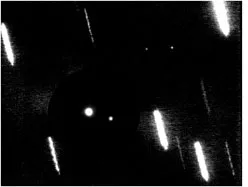
Photo by David Tholen.
In the image, Pluto is the larger circle. Next to it, the moon Charon. Above, to the right it is also possible to see the small moons Nix and Hydra.
Pluto is a small planet (now called a "dwarf") 2,300 km in diameter, that is, smaller than our Moon, and about 4.8 billion kilometers away when the image was taken.
To obtain the image, the adaptive optics technique was used, with a resolution of 35 milliarcseconds.
More images will be taken so astronomers can track the moons as they orbit the planet. Better observations mean the orbits will be measured more precisely, which ultimately will enable a more accurate determination of the planet's mass.
Knowing its mass precisely is difficult due to how hard it is to observe. When it was discovered and its distance determined, it was thought to be a giant planet because of its great brightness and distance. More observations showed that it was actually small but reflected a lot of light.
In a few years, we will no longer have to settle for images of bright and somewhat blurry dots like the photo above. The New Horizons spacecraft will show us the true face of this distant inhabitant of our solar system.
Clarification
It is possible to find better images of Pluto. For example, on HubbleSite, which is actually a computer reconstruction based on the light collected from the planet. Although Hubble is in orbit and is not as limited by exposure times, it is a much smaller telescope (2.3 m) than the Keck ones (10 m each). The latter also combine through adaptive optics, so for small objects, Keck will obtain better images.
Sources and related links
- Note on BadAstronomy
- Note on University of Hawaii