Mysterious gigantic structures (the size of Earth), whose shapes recall prehistoric fossils, appear on the surface of the Sun.
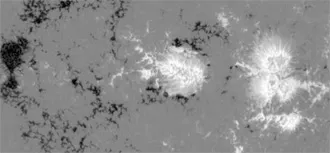
Magnetic map of sunspot 10926. Hinode JAXA/NASA.
"We had never seen anything like this before," says Lika Guhathakurta, a solar physicist, at NASA headquarters.
Last week Guhathakurta sat among the nearly two hundred colleagues who attended the "Living with a Star" seminar, held in Boulder, Colorado, and watched in astonishment the video presented by Saku Tsuneta of Japan, which showed sunspot 10926 crossing the turbulent solar surface. Suddenly, a planet-sized object appeared before their eyes and surprised everyone with the shape it took.
"It looks like a prehistoric trilobite," said Marc De Rosa, a scientist at the Solar and Astrophysics Laboratory of Lockheed Martin in Palo Alto, California. "To me it looked like the moment when cell mitosis occurs, when duplicated chromosomes form two daughter cells," replied Guhathakurta.
Click on the image to decide what the mentioned object resembles:
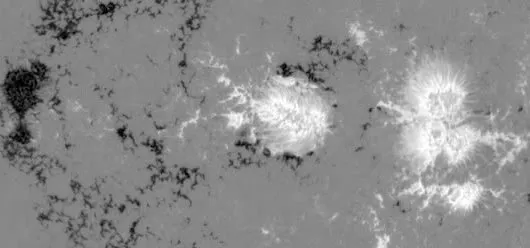
A map of the magnetic field of the prominent sunspot 10926 filmed by Hinode in December 2006.
"This video is a magnetogram—a dynamic map that traces the intense magnetic field of sunspots," explains Guhathakurta. "The black color represents negative polarity (S), while white represents positive polarity (N)."
The data were collected by the Hinode spacecraft of the Japan Aerospace Exploration Agency, which was launched into space in September 2006 on a mission to study sunspots and solar storms. "So far, this is the highest-resolution magnetogram taken from space," says Tsuneta, principal investigator of the Hinode project at the National Astronomical Observatory of Japan in Tokyo. "It is showing us things we had never seen before."
Magnetograms are the best resource for studying sunspots. Why? Although sunspots appear to have a solid and robust consistency, the reality is they are not made of matter. Sunspots are knots of magnetism created by the Sun's internal dynamo. Born from the Sun's interior, these knots jump to the solar surface from where they can move, link, split, and even seem to "swim."
"Sometimes this process of movement and linking becomes intense," says Guhathakurta. "Magnetic fields become destabilized and explode, producing a powerful solar flare." The effects are multiple: these flares can disrupt communications on Earth, disable satellites, and can even endanger astronauts through the lethal radiation storms they produce. And, on the "good" side, they produce the beautiful auroras—the famous Northern Lights. Although researchers have been studying flares for over a century, they still cannot offer an accurate forecast of their occurrence—something that astronauts in orbit or on their way to the Moon would undoubtedly appreciate. One of the most important goals of the Hinode mission is to improve this situation.
The quality of the data recorded with Hinode managed to amaze the participants of the "Living with a Star" seminar. "The sensitivity of the Hinode Solar Optical Telescope is much greater than that of any other telescope we have launched before. This allows Hinode to detect even the weakest magnetic fields." By observing the jumping and flowing of magnetism and the surprising shapes that emerge, "we hope to understand the behavior of sunspots and predict their eruptions."
First, however, they have to face the trilobite. "We still have a lot to do to solve this problem," says Guhathakurta, "but what a wonderful problem we have on our hands."
Further discussion
Observations of sunspot 10926, made by Hinode, challenge traditional theories about sunspot formation. Before Hinode existed, a solar physicist might have described the birth of a sunspot as follows:
"Sunspots form when a 'rope' of intense magnetic field reaches the Sun's visible surface (the photosphere). Magnetic ropes develop in the depths of the photosphere and emerge as an arch-shaped structure. When this arch crosses the surface, it gives rise to a pair of sunspots. Similar to a bar magnet, one end of this arch has a positive polarity (North), while the other end has a negative polarity (South)."
However, the data related to the trilobites exhibit a different process:
"The manifestation of sunspot magnetism develops in a very complex way, in which larger and more coherent structures seem to form from smaller structures," says Marc De Rosa, a researcher at the Solar and Astrophysics Laboratory of Lockheed Martin in Palo Alto, California.
So, the trilobite video, while entertaining, is not simply entertainment. "It has shown us something that is absolutely new about the origin of sunspots," says Lika Guhathakurta.
Credits:
Hinode is a Japanese mission developed, launched, and operated by ISAS/JAXA, in collaboration with NAOJ, NASA, and STFC (UK). ESA and NSC (Norway) have provided additional support for operations.
Sources and related links
Note on Ciencia@NASA