The New Horizons spacecraft reveals changes on Jupiter. The spacecraft passed by the planet, on its journey toward Pluto, on February 28. The probe was the eighth to visit the giant planet, but a combination of trajectory, timing, and technology allowed it to explore details that none had been able to before.
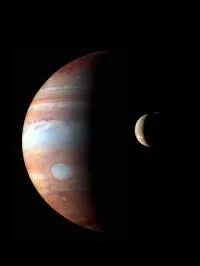
NASA/Johns Hopkins University Applied Physics Laboratory/Southwest Research Institute
The New Horizons team presented its latest detailed data analyses at the Meeting of the American Astronomical Society in Orlando, Florida and in a special section of the October 12 edition of Science. The section includes nine technical papers written by team members and collaborators.
From January to June, the seven science instruments aboard the spacecraft performed more than 700 observations of the Jovian system, most of which were during the 8 days of closest approach to the planet.
"The Jupiter system is constantly changing and New Horizons was in the right place at the right time to see some exciting developments" says Jeff Moore of NASA Ames Center.
The study of the system's weather was a priority. Thanks to the instruments, the spacecraft was able to see ammonia clouds forming and lightning flashes in the polar regions. Detailed measurements were made of the waves that run across the planet and indicate violent storm activity. Additionally, close-up images were taken of the Little Red Spot, half the size of the Great Spot, but 70% of Earth's diameter.
With various light ranges and viewing angles, the clearest images of Jupiter's faint ring system were captured.
Investigations of the four large moons focused on Io, the closest to the planet and whose active volcanoes expel tons of material into the Jovian magnetosphere. The global map of the moon places it as the most active body in the solar system, showing more than 20 geological changes since the Galileo spacecraft observed it in 2001.
Furthermore, Jupiter's magnetic tail and its interaction with material from Io's volcanoes were studied.
Sources and related links
- Note on EurekAlert
- Images on New Horizons