On Earth, thieves steal all sorts of things: diamonds, art, or suitcases full of money. In space, gas—the raw material for making stars—is a commodity worth stealing.
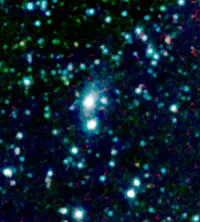
NASA/JPL-Caltech/P. Ogle (Spitzer Science Center)
New observations from the Spitzer Space Telescope reveal a distant, massive galaxy in the act of stripping vast reserves of gas—the equivalent of a billion Suns—from its small neighboring galaxy.
The stolen gas, which heated up during the robbery, will cool and become new stars and planets.
"We may be seeing the largest galaxy in a rare and brief stage of its rebirth from an old galaxy to a young one filled with bright stars," says Patrick Ogle of Spitzer, author of a new paper appearing in the October 20 issue of Astrophysical Journal.
The thief galaxy, called 3C 326 North, has a mass similar to the Milky Way; and its victim, 3C 326 South, has about half that mass. They are close enough to gravitationally disturb each other and eventually collide. Mergers are common in the Universe, and this could be the clearest example.
Ogle and his colleagues initially intended to study a group of distant galaxies called radio galaxies, a billion light-years away. These objects emit jets of matter from the black holes at their centers. Although these jets are powerful, their black holes are relatively dormant. When astronomers scanned 72 galaxies using Spitzer's infrared vision, they noticed a handful that were somewhat unusual.
The most extreme of this group, 3C 326 North, was soaked in enormous amounts of hydrogen gas, reaching temperatures up to 730 degrees Celsius. This gas, called molecular hydrogen because it contains molecules of two hydrogen atoms bonded together, is a building block of galaxies, stars, and planets. On Earth, it is a potential alternative fuel for cars, for example. Molecular hydrogen is not visible to optical telescopes, but when heated it glows at infrared wavelengths that the Spitzer Telescope can capture.
Since 3C 326 North is not busy making new stars, it is unusual for it to have so much gas. Upon closer investigation, the scientists noticed what appeared to be a tail of stars connecting the North galaxy to the South one. From this, it is inferred that the pair is interacting.
The victim galaxy, deprived of its gas, will not produce new stars, although nothing is certain, as the galaxies could well merge and thus share their bright possessions.
Sources and related links
Press release on Spitzer