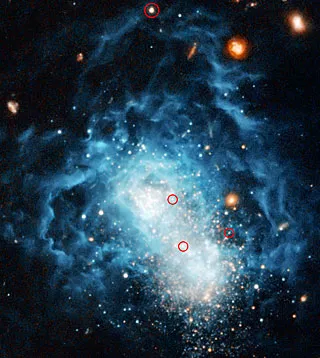
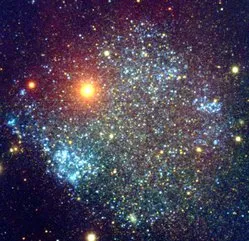
Cosmological simulations allow us to understand how galaxy interactions affect the star formation rate.
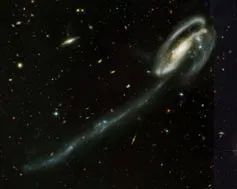
The Tadpole galaxy and its "tail", generated by a galactic interaction.
Risa Wechsler of the Kavli Institute and her collaborators have devised a powerful technique to study how interactions between galaxies affect star formation.
Their results illuminate the process of galactic evolution.
In the primitive Universe, the star formation rate was higher than today's. Galaxies collided frequently, spawning a profusion of new stars with each encounter. Although those events are now relatively infrequent, galactic interactions continue to forge stars and shape galaxies. Observational studies suggest that those interactions increase the star formation rate, but there is little consensus on the frequency and magnitude of the events.
"To study this, one needs to observe pairs of galaxies, which have recently interacted or are about to do so, and determine if the star formation rate is higher or lower than similar galaxies that have not interacted," says Wechsler.
The idea, however, is difficult to execute. Galactic interactions are highly complex and dynamic.
One complication is that most galaxies exist in groups in which it is difficult to distinguish the immediate effects of a solitary interaction.
To overcome this, Wechsler used a cosmological simulation of dark matter and galaxies. "The simulation allows us to see statistically how galaxies connect with their environment. This allows us to estimate the tendency for pair formation and then define selection criteria that would give us isolated pairs and appropriate controls."
Elizabeth Barton, a collaborator from the University of California, then used that criterion to analyze a group from the 2df study. The analysis revealed that 14% of galaxies in close pairs exhibit star formation rates stimulated by at least a factor of 5 and on average a factor of 30.
"Our selection criterion allows us to limit how the star formation rate changes in interactions and will help us understand how star formation contributes to galactic evolution."