New images from the Hubble Space Telescope reveal the true nature of what, in previous studies, appeared to be an elliptical galaxy.
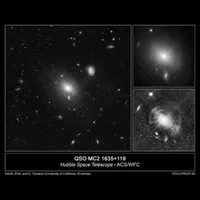
The images show shells of stars around a bright quasar, known as MC2 1635+119, which dominates the galactic center. The stellar bubbles appear to indicate a titanic collision with another galaxy in the relatively recent past.
The collision is also feeding the supermassive black hole at the center of the galaxy. The accretion onto the black hole is the source of the quasar's energy. This observation supports the idea that at least some quasars are born from galactic interactions.
"Most quasars were active in the early Universe, which was smaller, so collisions were more frequent," says Gabriela Canalizo of the University of California, Riverside.
Previous studies of this galaxy with ground-based telescopes showed a normal, elliptical galaxy, containing an old population of stars. The sharp vision of Hubble and its ACS and the spectroscopic precision of the W.M.Keck in Hawaii were needed to unveil the faint stellar bubbles.
The new observations reveal at least five inner shells and additional debris from the galactic center. The bubbles resemble the ripples that form in a pond when a stone is thrown. They formed when a galaxy was pulled by tidal forces during the collision. Some of the stars were swept out of the gravitational field, creating the bubbles or shells. The farthest one is 40,000 light-years away from the center.
Computer simulations estimate that the encounter occurred 1.7 billion years ago. The merger itself took place over a few hundred million years and ignited a whirlwind of stellar births. Data from Keck reveal that many of the stars in the galaxy are 1.4 billion years old, which is consistent with the age of the merger. This activity occurred before the light left the quasar and began its long journey to Earth.
The stars are mixing and eventually the shells will dissipate.
"This could be a transient phase, common in ellipticals, lasting only 100 million to a billion years," adds Canalizo.
"The formation of bubbles and the current quasar activity could have been triggered by an interaction between two large galaxies or between a large one and a smaller one. High-resolution spectroscopic observations are needed to determine the type of merger," says Nicola Bennert, Canalizo's colleague.
The results will appear in the November 10 edition of The Astrophysical Journal.