A new contribution from the science video site ScienceHack, about the immensity of our galaxy.
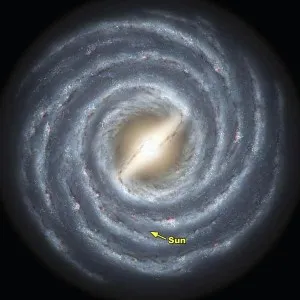
Milky Way
Video:How Big Is The Galaxy?
Galaxies come in different shapes and sizes and contain billions of stars. It is said there are more stars in the Universe than grains of sand on all the beaches in the world. Stars are not scattered randomly but grouped in clusters called galaxies.
Our solar system is located in a galaxy three-quarters of the way from the center. We call our galaxy the Milky Way. On very dark nights it can be seen across the sky. And, how big is it? It is so big that we cannot measure it in miles or kilometers, the numbers would be too large. Instead we must use another measure called a light-year. What is a light-year? If you turn on a light, it leaves the source it comes from and reaches your eyes instantaneously. Now, if you stand 186,000 miles (299,274 kilometers) away, which is two-thirds the distance to the Moon, the light will take 1 second to reach you. Are you good at math? Good, multiply 299,274km x 60 sec and you get over 17 million. If you stand at that distance, 17 million kilometers, the light will take 1 minute to reach you.
Now multiply that by 60 minutes and you'll know how far light travels in one hour. Multiply that result by 24 (hours) and then the light will take a day to reach you. You'll see you're up to 25 thousand million!
Now a more difficult step. Multiply that number by 365, the number of days in a year, and this huge number is 1 light-year. Our galaxy is 100 thousand light-years in diameter. 100 thousand light-years! A ridiculous number to understand.
Let's put it another way: if you travel at 299,000 kilometers per second (the speed of light) it will take you 100,000 years to go from one end of the galaxy to the other. Okay, it's still a very large number. Let's try to make it more understandable. If the Sun were a ball one meter in diameter, then Earth would be a pea 100 meters away. And Pluto would be a grain of rice 4km (or one light-day) from the Sun. On this scale, the nearest star Alpha Centauri, which is 4 light-years away, would be on the Moon.
There are only seven stars within 10 light-years of Earth. The galaxy closest to us is the Andromeda galaxy and it is 2.2 million light-years away.
So without Captain Kirk and his ship with Warp speed, it seems we'll be staying home for a long time.
Sources and related links
- Video on ScienceHack
- Online unit converter