The European Commissioner for ESO, Janez Potočnik, captured an incredible image of a spiral galaxy during his visit to the VLT.
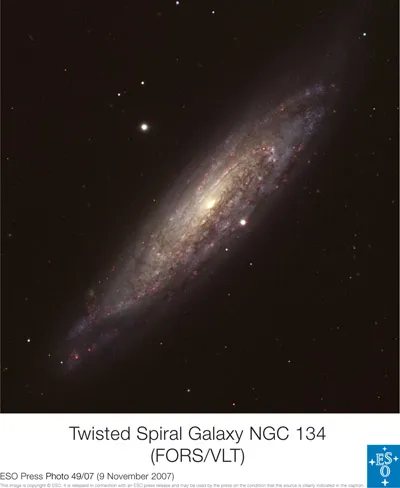
ESO PR Photo 49/07
During his visit to the VLT at Paranal, the European Commissioner for Science, Janez Potocnik, participated in an observing sequence and took images of a beautiful spiral galaxy.
The visit took place on October 27 and he recounted his experience on his blog.
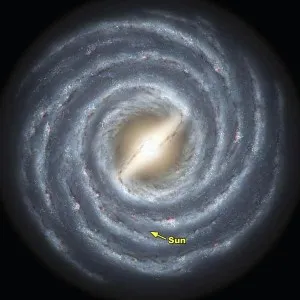
Known until now as a simple number in a catalog, NGC 134, the "island in the Universe" observed by Janez is full of remarkable attributes. Like our Milky Way, it is a barred spiral.
A feature that characterizes it is its warped disk. Galactic disks are usually imagined as flat structures of gas and stars around the center of the galaxy; a warped disk is a structure that, when viewed edge-on, looks like a curved disk left in the Sun for too long.
But it is not atypical. More than half of spiral galaxies show warps of one kind or another and our galaxy also has one.
Many theories are postulated to explain these structures. One possibility is that they are the product of interaction or collision between galaxies. This can also produce tails of material being expelled from the galaxy. The VLT image of NGC 134 also appears to have a gas tail.
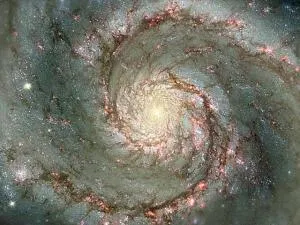
The image also shows that the galaxy has its regions of ionized hydrogen (HII regions) along its spiral arms. Seen in the image as red elements, they are bright clouds of hot gas in which stars are forming. The galaxy also shows prominent dust lanes across the disk, obscuring part of the galaxy's light.
Studying galaxies like NGC 134 is an excellent way to learn more about our own galaxy.
NGC 134 was discovered by Sir John Herschel at the Cape of Good Hope and is located in the constellation Sculptor. At 60 million light-years away, when the light captured by the VLT originally left the galaxy, a dramatic episode of mass extinction wiped out the dinosaurs on Earth. Even so, by cosmological standards, the galaxy is not very far away. It is a dominant member of a small group belonging to the Virgo Supercluster and is one of the 200 brightest galaxies in our skies.
Sources and related links
Press release at ESO