The image shows where solar eclipses have been seen from the year 0 to 2000 AD.
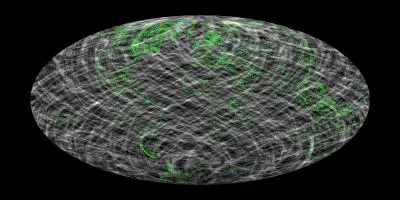
Image by Ivan Gonçalves
The composition was possible thanks to Bessel functions. Friedrich Wilhelm Bessel was a German mathematician, astronomer, and systematizer of Bessel functions (which, despite their name, were discovered by Daniel Bernoulli) for the analysis of orbital motions.
In the image, the whiter or brighter the element (pixel) on the globe, the larger the number of solar eclipses visible at that point. It is notable that there are more total solar eclipses in the Northern Hemisphere than in the Southern. This is due to the fact that most eclipses occurred during the months of May to August (summer in the Northern Hemisphere), when the Earth is a few million kilometers from the Sun and thus the apparent diameter of the solar disk is slightly smaller. The result is that the apparent diameter of the lunar disk is just a little larger than the solar one, so there are more total eclipses but fewer annular eclipses. Annular eclipses occur when the Moon does not completely cover the Sun and a ring of light remains around the edge of the lunar disk. The next one will be on February 7, visible in Antarctica, Australia, and New Zealand.
The area that witnessed the greatest number of total solar eclipses is located in northern Russia (Lat: 74.1°N, Lon: 120.5°E) with 19 total eclipses. During the past 2000 years, 99.4% of the Earth's surface has experienced at least one total solar eclipse.