A team of astronomers announced the discovery of a fifth planet around 55 Cancri, making it the only star -apart from the Sun- to host such a system.
The discovery comes after 19 years of observation of 55 Cancri and represents a milestone for the Carnegie planet search team which this year celebrates the 20th anniversary of its first attempt to search for exoplanets by analyzing the wobbles they cause to their host star.
The team's long history of measurements - more than 300 for the star in question alone- made the discovery of the five-planet system possible, says Geoffrey Marcy, a professor at Berkeley, who with Paul Butler, now at Carnegie, began observations of many nearby stars at the University of California's Lick Observatory in 1987.
The peculiar system of 55 Cancri, located 41 light-years away in the direction of the constellation of Cancer, is also notable because its four inner planets and its outer giant resemble our solar system.
"This system is interesting because there is a giant planet at 6 AU (Astronomical Units) and four smaller planets within 0.8 AU, with a large gap in between, just where one would expect to find an Earth-sized planet," says Marcy.
According to author Debra Fischer, of the University of San Francisco, the fifth planet is in the habitable zone of the planet where water can exist as a liquid. Although the planet is a giant ball of gas, liquid water could exist on the surface of a moon or on other rocky planets that might be found in the zone. "Right now we are looking in the gap between the 260-day orbit of the new planet and the 14-year orbit of another gas giant and if you have to bet, bet that there is more material orbiting there."
Fischer points out that whatever occupies that gap must be another Neptune-sized or smaller planet, because something larger would destabilize the orbits of the other planets. All the planets around 55 Cancri are in stable, nearly circular orbits, like the eight planets in our solar system. Jupiter is located at 5.2 AU from the Sun, while Mercury and Venus are at about 0.72 AU. Earth and Mars are at 1 and 1.5 AU respectively.
"We have not found a twin to our solar system, because the four planets close to the star are Neptune-sized or larger," says Marcy.
The new discovery, using data from the Lick Observatory and the W.M. Keck in Hawaii, has been accepted for publication in Astrophysical Journal.
Although more than 250 exoplanets have been discovered, only one star, mu Ara, in the southern sky, is known to have four planets.
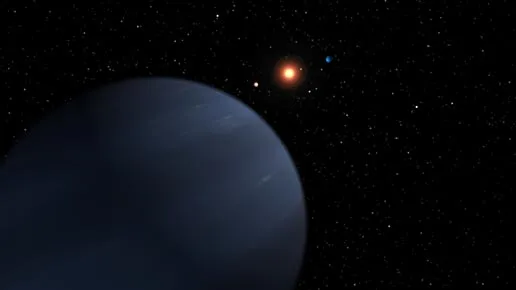
The new fifth planet discovered in 55 Cancri is larger -about half the size of Saturn or about 45 times the mass of Earth- and orbiting at 0.785 AU in 260.8 days. Since 55 Cancri is older and more diffuse than our Sun, the habitable zone - the region where planetary temperatures are favorable for liquid water- is closer to the star than in our Sun, and includes the new planet.
Sources and related links
- Note on EurekAlert
- Note on Keck
- Note on BadAstronomy
- Article on NASA