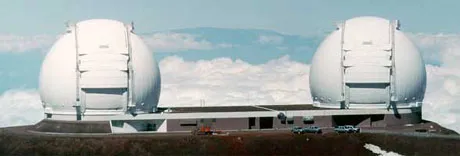
NASA selected three teams of scientists to begin studying dust disks around nearby stars in February 2008, using the Keck Interferometer on Mauna Kea, Hawaii. This sophisticated new system combines the observing power of the two large Keck telescopes into a megatelescope.
The announcement was made upon completion of the technology phase of the Keck interferometer, in which its detectors, optics and control system were installed, tested and integrated.
The new selected teams are led by the following principal investigators:
• Phil Hinz, University of Arizona, Tucson, Ariz.
• Marc Kuchner, Goddard Space Flight Center, Greenbelt, Md.
• Eugene Serabyn, Jet Propulsion Laboratory, Pasadena, Calif.
The teams will study known stars with debris disks and will look for signs of dust around other stars.
Some debris disks are remnants of planet formation, others contain material from asteroid collisions, which in our solar system is called "zodiacal dust". This can be seen when sunlight scatters dust grains to produce a faint band of light visible against the dark sky after sunset or before dawn.
The Keck Interferometer science teams will search for disks comparable to those, though much brighter, in other planetary systems.
The Keck interferometer links the observatory's two 10m telescopes. It is part of NASA's search for planets orbiting other stars, through JPL.
Sources and related links
- Note at JPL
- Planet search PlanetQuest
- Note on Keck Observatory site
- What is the Keck Interferometer?
About the images
View of the Keck Telescopes domes. Credit JPL.