Not only a piece of the Universe that was believed to have been found in 2002, apparently, was lost again, but it seems to have taken some friends with it, according to a new study from the University of Alabama. The new calculations could leave the mass of the Universe between 10 and 20% lighter than previously calculated.
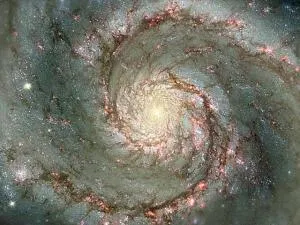
M51, the Whirlpool Galaxy. Credit: NASA and The Hubble Heritage Team (STScI/AURA) Acknowledgment: N. Scoville (Caltech) and T. Rector (NOAO))
The same group from the University of Alabama in Huntsville (UAH) that found what theoretically was a significant fraction of "missing mass," has discovered that some X-rays coming from intergalactic clouds of hot gas are, instead, probably caused by light electrons.
If the energy source of the X-rays is small electrons instead of heavy atoms, it's as if billions of lights that were thought to come from billions of aircraft were actually coming from very bright fireflies.
"This means that the mass of these X-ray emitting clouds is much less than we initially thought," says Dr. Max Bonamente, assistant professor at UAH. "A significant portion of what we thought was missing mass appears to be these 'relativistic' electrons." Traveling at nearly the speed of light (and therefore "relativistic"), these light electrons collide with photons from the cosmic microwave background. The energy from the collisions converts the low-energy microwave photons into high-energy X-rays.
Although the X-ray emitting atoms were thought to be finely distributed through space (less than one atom per cubic meter), they could have filled millions of billions of cubic light-years. Their cumulative mass was thought to be 10% of the mass and gravity needed to hold galaxies, clusters, and perhaps the Universe itself together.
When Bonamente and his colleagues analyzed data gathered by several satellite instruments, including the Chandra X-ray Observatory, they found that the energy of those extra rays was not what it should be. "We have never been able to detect emission lines associated with those detections," he explained. "If it were due to cold gas, it would have emission lines."
"The best and most logical explanation seems to be that a large portion of the energy comes from electrons colliding with photons instead of atoms and ions, which should have recognizable emission lines. Finding these electrons, however, is like finding 'the tip of the iceberg,'" says Bonamente, because they would not be limited to emitting only X-ray signals. The signal from these electrons would also form part of the previously observed X-rays, which would reduce the amount of mass of the hot gas in the centers of galaxy clusters.
Previously, astrophysicists used the energy coming from these clusters to calculate how much mass is needed to achieve the equilibrium seen there; too much mass and the cloud would collapse; too little and the hot gas cloud would expand. Since the energy of these hot clouds can be measured precisely, it was thought that the mass of the cloud could be calculated with reasonable confidence. Instead, says Bonamente, if a significant portion of the total X-ray energy comes from fast electrons, it would deceive us into thinking there is more gas than there actually is. It means we must revise how we calculate the mass of the gas and the total mass.
The research results were published in the October 20 edition of Astrophysical Journal.
Sources and related links
- University Of Alabama In Huntsville (2007, November 5). Big Chunk Of The Universe Is Missing -- Again. ScienceDaily. Retrieved November 7, 2007, from ScienceDaily
- Note at UAH