New observations from NASA's Spitzer Space Telescope suggest that natural satellites like Earth's - which form from tremendous collisions - are infrequent in the Universe, reaching only between 5 and 10 percent of planetary systems.
"When a moon forms from a violent collision, dust should be expelled everywhere," says Nadya Gorlova of the University of Florida and author of the new study appearing in the November 20 edition of Astrophysical Journal.
"If many moons formed, we would have seen dust around many stars, but that didn't happen."
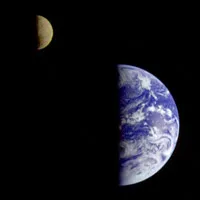
Scientists believe that the Moon originated 30 to 50 million years after the Sun and after our rocky planet began to take shape. It is thought that a body as large as Mars collided with Earth, breaking off a piece of its mantle. Some of the resulting debris fell into an orbit around the planet and eventually coalesced into the Moon we know. The other moons in our solar system would have formed either simultaneously with their planets or would have been captured by the planets' gravity.
Gorlova and her colleagues looked for the dusty signs of similar collisions around 400 stars, all of similar age, about 30 million years, nearly the age of our Sun when the Moon formed. They found that only 1 of the stars is immersed in dust. Taking into account the time the dust should remain and the age range in which moon-forming collisions can occur, the scientists calculated the probability that a solar system could generate a moon like Earth's at 5 to 10 percent.
"We don't know if the collision we witnessed around the star is going to produce a moon, so these events could be even less frequent than suggested by our calculations," says George Rieke of the University of Arizona and co-author of the paper.
Furthermore, the observations tell astronomers that the planet formation process slows down after 30 million years from the star's formation. Like our moon, rocky planets are created by collisions that also generate dust. This process is thought to last between 10 and 50 million years after the star's birth. The fact that Gorlova and her team found only 1 out of 400 stars with dust presumably generated by collision indicates that the stars (which were 30 million years old) would have finished producing their planets.
"Astronomers have observed young stars with dust around them for more than 20 years," says Gorlova. "But those stars are usually so young that their dust could have been generated by the planet formation process. The star we have found is older, the same age as our Sun when it finished making planets and the Earth-Moon system had just formed."
Paper:
Debris Disks in NGC 25471
N. Gorlova ,2 Z. Balog ,3 G. H. Rieke ,3 J. Muzerolle ,3 K. Y. L. Su ,3 V. D. Ivanov ,4 and E. T. Young 3
Sources and related links
- Note on Spitzer
- Note on JPL
- Related notes