The Japanese Space Agency JAXA and the television network NHK have successfully obtained the first images of the Earth "rising" from behind the Moon in High Definition, thanks to the camera carried by the probe orbiting our satellite at an altitude of 100 kilometers since October 18, 2007.
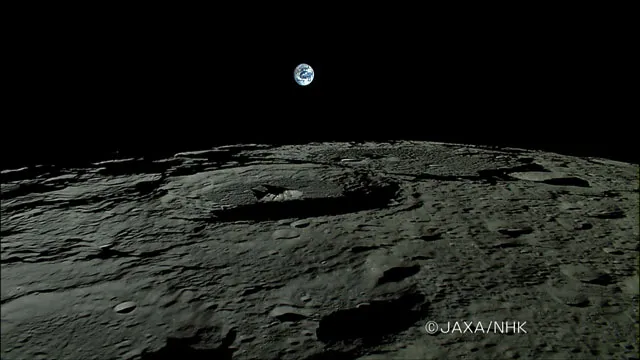
"Earthrise" taken by the camera on board Kaguya on November 7. In the image, the lunar surface is near the North Pole and the Arabian Peninsula and the Indian Ocean can be observed on Earth.
The Kaguya probe (or Selene) has successfully obtained for the first time high-definition images of the Earth showing an impressive sequence of the blue Earth floating against black space. These are the first high-definition images of our planet obtained from 380,000 kilometers away in space.
The image taken was made by the high-definition camera (HDTV) on board the probe, designed and built by NHK. These moving images and their data were obtained by the Usuda Space Center and later processed by NHK. Telemetry data indicated that the probe is in perfect health.
Note: As clarified in SpaceRef, we use the expression "Earthrise" in this press release, but Earthrise is a phenomenon only visible from satellites orbiting the Moon like Kaguya or the Apollo spacecraft. Earthrise cannot be observed by a person on the lunar surface as they would always see the Earth in the same position.
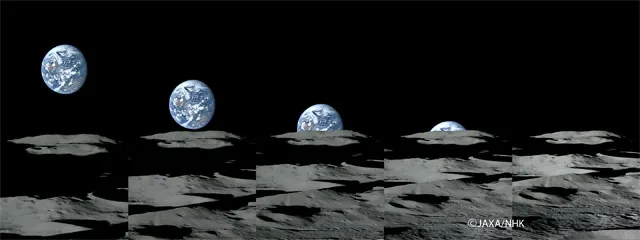
The images are of the Earth "setting" on the Moon's horizon at the South Pole. It took 70 seconds from left to right.
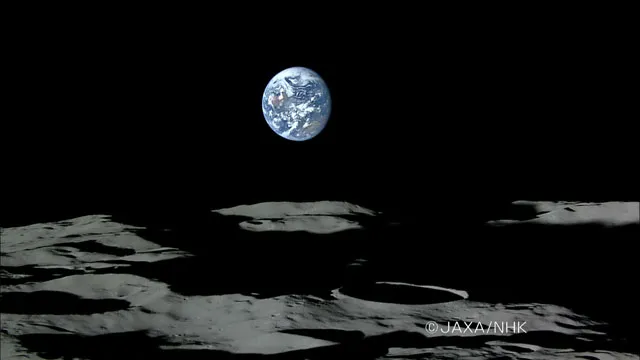
Image from November 7. The Moon's surface is near the South Pole and we can see the Australian continent (center-left) and the Asian continent (bottom right). (In the image, the top part of the Earth is the Southern Hemisphere, so Australia appears upside down)