New studies on galaxy evolution maintain that they are born as small spirals with active star formation to age into large ellipticals with no stellar production.
At the beginning of the 20th century, Edwin Hubble made the surprising discovery that our galaxy was not the only one. It is one of many galaxies or "island universes" swimming in the sea of space.
Now, a century later, NASA's explorer GALEX is helping to understand galactic evolution. Since its launch in 2003, the mission has studied tens of thousands of galaxies in ultraviolet light. The results provide evidence for the "nurture" theory which holds that elegant spiral galaxies and ellipticals are linked in their evolution.
According to this theory (called "nurture" as opposed to "nature" which means nature), a typical young galaxy begins its life as a spiral actively generating stars. Over time, the spiral would merge with another spiral or perhaps with an irregular galaxy. Eventually, the galaxy would lower its stellar production and settle as an elliptical.
"Our data confirm that all galaxies begin their lives forming stars," says Chris Martin, the principal investigator of the Galaxy Evolution Explorer (GALEX) at the California Institute of Technology. "Then, through a combination of mergers, fuel depletion and perhaps suppression by black holes, galaxies eventually stop their star production."
When astronomers talk about galaxies today, they tend to refer to them by their color, either blue or red, rather than by their shape. Most blue galaxies are small spirals or irregulars and most red ones are large ellipticals, although there are exceptions.
Their color indicates how actively they are producing new stars. Young stars shine in ultraviolet or blue light, so galaxies appear blue and busy with stellar production. Older stars emit infrared or red light, so galaxies that look red have stopped their star formation. Almost half of the galaxies are blue and the other half red.
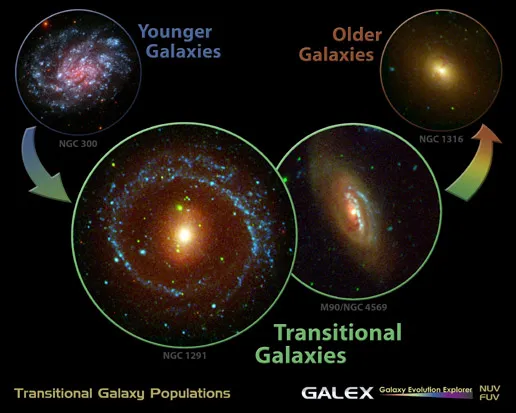
Scientists have postulated that blue galaxies grow to become red. They proposed that something happened to blue galaxies that caused the cessation of star formation and made them mature into passive red galaxies. For this evolutionary theory to be true, there should be a population of "infant" galaxies in the process of transitioning from blue to red or from young to old. But such a cosmic transformation should take billions of years. How could astronomers study such a long process?
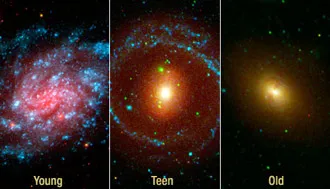
Examples of young, infant and old galaxies. NASA/JPL-Caltech
One solution is to look at large numbers of galaxies. Imagine a hypothetical alien trying to understand human evolution with only a handful of photos of people of different ages. The aliens might assume that children grow into adults, but they could better understand the typical life of a human if they looked at many, many boxes of photos.
The Galaxy Evolution Explorer was designed to provide astronomers with a similar portfolio of galaxies. Its data has allowed scientists to find a significant number of "infant" galaxies and thus prove that young spirals or blue ones will grow into older elliptical or red galaxies.
"The nurture theory predicts that there would be galaxies in transition," says Martin. "Finding these galaxies requires ultraviolet light and since they are rare, we must look at many. GALEX allows us to do that."
Visible light data from the Sloan Digital Sky Survey also helped establish the age of the "infant" galaxies and the star formation rates. These discoveries suggest that some of the young ones are maturing rapidly. The results can be found in a report in The Astrophysical Journal, 670:279-294, 2007 November 20
Nature vs. Nurture
The dichotomy between heredity and environment or between Innatism and learning was first stated by Galton in the form Nature/Nurture. It has often been seen as opposing poles between which no intermediate positions were possible. Today it is seen more as a gradation of influential elements.
These terms, originally applied to the study of human behavior, are transferred to the cosmological context of whether galaxies are as they are due to natural determinism or due to their interaction with each other.
Sources and related links
- Note at JPL
- Note at Galex
- Related notes
Image credits:
NGC 300 : NASA/JPL-Caltech/Las Campanas Observatory
NGC 4569 : NASA/JPL-Caltech/Palomar 1.5m
NGC 1291 : NASA/JPL/CTIO
NGC 1316 : NASA/JPL-CTIO