As humanity becomes a space civilization, we will encounter difficult situations that will challenge current laws and concepts of nationality. For example, what will your nationality be if you are born on the Moon? Or if two astronauts fight while in orbit, what laws apply? If you break a piece of an international module, who do you send the check to?
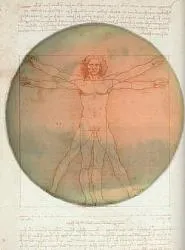
Da Vinci's man on Mars
Credits: 1. Human figure in a circle, L. da Vinci, ca. 1485-90, www.davincisketches.com - 2. Mars image, ESA © 2007 MPS OSIRIS Team
During a recent conference in Europe, schoolchildren and scientists gathered to propose unusual circumstances that could occur in space exploration.
Laws in space are currently covered by the Outer Space Treaty of 1967. It has been ratified by 98 states and follows the tradition of maritime law in which states have legal jurisdiction over their own vessels.
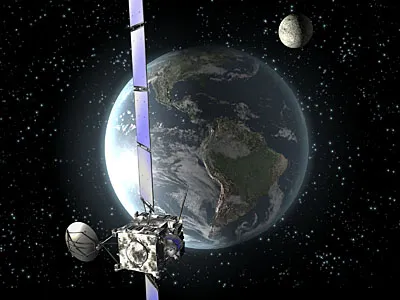
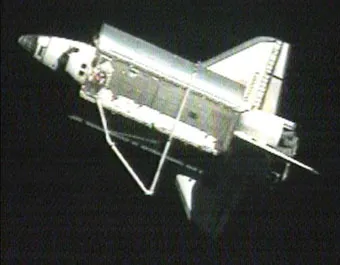
But what happens when a spacecraft has been built by several nations, like the Columbus module that will be sent to the space station in December?
The recent conference, called "Humans in Outer Space – Interdisciplinary Odysseys" was held on October 11-12 in Vienna, Austria.
The partner nations in the construction of the International Space Station have already rejected a proposal for the entire station to fall under U.S. law.
"It was agreed that each state would register its own separate elements, which means you now have a piece of the United States attached to a piece of Europe attached to a piece of Japan in outer space, legally speaking," says Dr. Frans von der Dunk of the International Institute of Air and Space Law at Leiden University.
Since each module is operated by a different nation, that could work. But not in cases like the Columbus module, which was built and operated by several European nations, in collaboration.
There are issues of criminal law (What happens if an astronaut from one nation attacks another in an international module?), patent issues (Where to patent an invention?), and civil order issues (if an astronaut damages a part of the station).
The meeting went further, wondering about the establishment of bases on the Moon and Mars. Since the 1967 treaty defines the Moon as a common heritage of mankind, it could not be considered the territory of any country. If a child were born there, what nationality would it be?
The 1979 United Nations Moon Agreement provides rules on how nations should explore the Moon, but does not go further into civil and criminal matters.
For now, if you are born on the moon, you are from nowhere.
Or a "lunatic"...
The Outer Space Treaty
dipublico.com.ar
Chair I of Public International Law
Faculty of Law - Universidad Católica de La Plata
Treaty on Principles Governing the Activities of States in the Exploration and Use of Outer Space, including the Moon and Other Celestial Bodies, of January 27, 1967
Agreement Governing the Activities of States on the Moon and Other Celestial Bodies, of December 5, 1979
Treaty at the U.S. Department of State