The ESA comet explorer probe is approaching its second encounter with Earth on November 13. The spacecraft operators are making every possible effort so that Earth's gravitational force provides it with the exact impulse it needs to continue on its course to its destination.
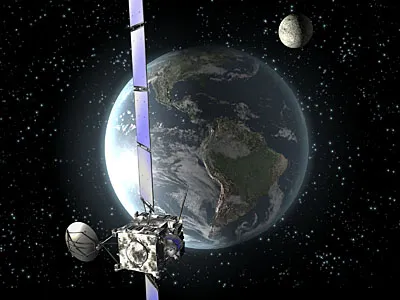
ESA (Image by C. Carreau)
The Earth flyby that Rosetta will perform this month is the third major stage in its 10-year journey to comet 67/P, Churyumov-Gerasimenko. The successful trajectory correction maneuver performed last month prepared the ESA comet explorer for its next encounter. The probe is now on the correct course to receive enough energy from Earth to save fuel in the future.
The closest approach will occur on November 13, 2007 at 21:57 CET, when Rosetta will acquire an acceleration greater than 45,000 km/h (about 12.5 km/s) relative to Earth. At that moment, Rosetta will be at an altitude of 5,301 km over the Pacific Ocean, southwest of Chile, at 63° 46’ south and 74° 35’ west.
The increase in energy that Rosetta will receive during its Earth flyby will allow it to cross the asteroid belt for the second time, observe Lutetia (the second of its target asteroids) and finally cross paths with comet 67/P Churyumov-Gerasimenko. The encounter will occur in 2014 at about 4 astronomical units, or 600 million km, from the Sun.
Intense activity is approaching...
During this Earth flyby, the highest priority will be given to spacecraft operations, as the maneuver is critical for the success of the mission as a whole. Furthermore, on the approach and departure trajectories of the Earth flyby, the Rosetta probe will be under solar illumination and, therefore, in unfavorable temperature conditions. That is why there will only be very limited windows in which the instruments can be used safely.
Despite this, some experiments will be activated, on the orbiter and on the Philae lander module, for calibration, scientific measurements and image capture purposes. The observations have been planned to take place during the period of closest approach, from November 7 at 01:00 CET until November 20 at 15:00 CET.
First, the Rosetta probe will point at Earth to carry out observations of the atmosphere and the magnetosphere, including the search for meteorites from space. It will capture images of urban areas in Asia, Africa and Europe, and then point at the Moon, to obtain images of the spectrum of the illuminated Moon. After moving away from its closest approach, the Rosetta probe will capture images of the Earth-Moon system from a distance.
Rosetta will be controlled from the ESA Space Operations Centre (ESOC) in Darmstadt, Germany.
During the Rosetta probe's Earth flyby, the ESA web portal will maintain a Rosetta swing-by blog with frequent updates and the latest information provided by the ESOC Rosetta-specific Control Room.
Sources and related links
Note on ESA