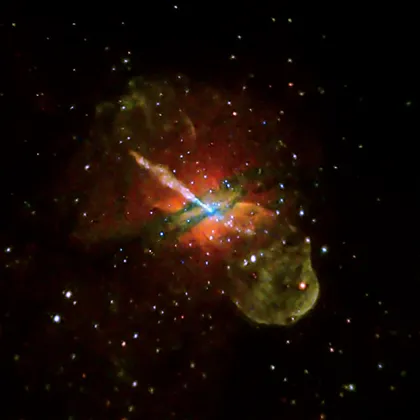
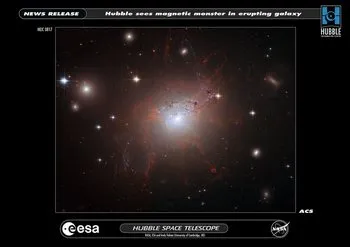
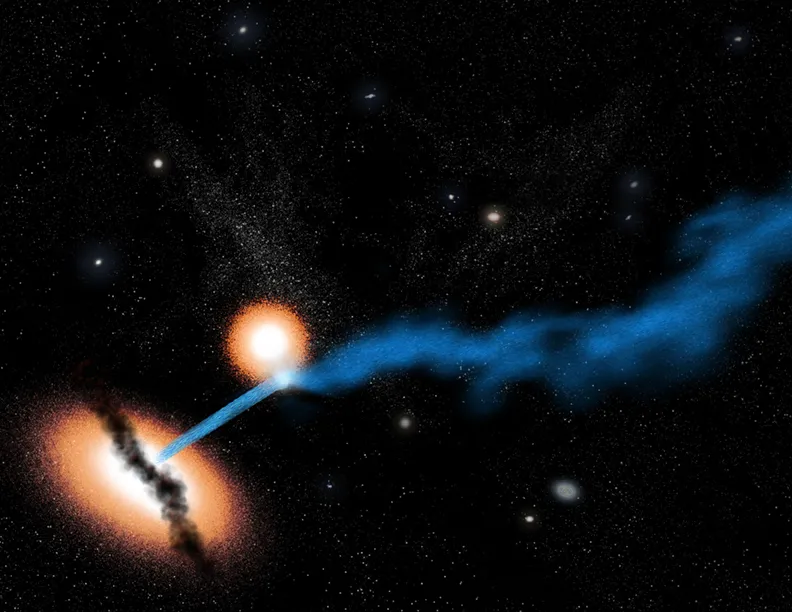
This image composite shows a jet from a black hole at the center of a galaxy striking the edge of another galaxy, the first time such an interaction has been found.
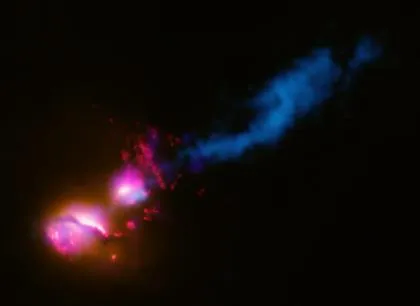
In the image, data from several wavelengths have been combined. X-ray data from Chandra (in purple), optical and ultraviolet from Hubble (in red and orange) and radio emissions from VLA and MERLIN (in blue) show how the jet from the main galaxy (bottom left) strikes its galactic companion (top right).
The jet impacts the companion at its edge and is altered and deflected, similar to how the stream of water from a hose will spread out when hitting a wall at a certain angle.
Each wavelength shows a different aspect of this system known as 3C321. The Chandra X-ray image provides evidence that each galaxy contains a supermassive black hole at its center. The Hubble images in optical light (orange) show the glow of stars in each galaxy. A bright region in the VLA and MERLIN radio image shows where the jet impacted—about 20,000 light-years from the main galaxy—dissipating some of its energy. An even larger region of radio emission detected by VLA reveals that the jet ends much farther from the galaxy, at a distance of 850,000 light-years. The Hubble UV image shows large amounts of hot gas in the vicinity of the galaxies, indicating that the supermassive black holes in both galaxies had a violent past. Weak emissions from Chandra, Hubble and Spitzer (not shown in this image) indicate that the galaxies orbit counterclockwise.
Since Chandra data indicate that particle acceleration still occurs in that region, the jet must have struck the companion galaxy relatively recently, less than a million years ago. This relatively short cosmic time makes the event a rare phenomenon.
This lethal galaxy will produce large amounts of high-energy radiation, which will cause severe damage to the atmospheres of any planets in the companion galaxy that lie in the path of the jet.
"We've seen many jets produced by black holes, but this is the first time we've seen one strike another galaxy," says Dan Evans, a scientist at the Harvard-Smithsonian Center for Astrophysics and leader of the study.
Jets from supermassive black holes produce large amounts of radiation, especially high-energy X-rays and gamma rays, which can be lethal in large quantities.
The results from Evans and his colleagues will appear in The Astrophysical Journal.
Sources and related links
- Press release on Chandra
- Paper: A Radio Through X-ray Study of the Jet/Companion-Galaxy Interaction in 3C 321, The Astrophysical Journal
Daniel A. Evans, Wen-Fai Fong, Martin J. Hardcastle, Ralph P. Kraft, Julia C. Lee, Diana M. Worrall, Mark Birkinshaw, Judith H. Croston, and Tom W. B. Muxlow
Received: 31 Jul 2007 Accepted: 30 Nov 2007
About the images
Fig. 1: First image of the note
Credit: X-ray: NASA/CXC/CfA/D.Evans et al.; Optical/UV: NASA/STScI; Radio: NSF/VLA/CfA/D.Evans et al., STFC/JBO/MERLIN
Fig. 2:
Artistic impression of 3C321 showing a jet of particles generated by the supermassive black hole of the main galaxy striking the edge of its companion galaxy.
Credit: NASA/CXC/M. Weiss)