The Hubble Space Telescope photographed the delicate and gigantic filaments shaped by a powerful magnetic field around the active galaxy NGC 1275. According to the researchers, this is the most spectacular example of the influence of these immense tentacles of extragalactic magnetic fields.
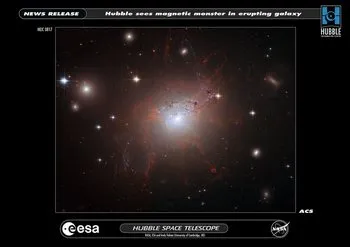
NGC 1275 is one of the closest giant elliptical galaxies and lies at the center of the Perseus galaxy cluster. It is an active galaxy, hosting a supermassive black hole at its center. Its most spectacular feature is its filaments of gas. These filaments are the only manifestation in visible light of the intricate relationship between the central black hole and the surrounding gas of the cluster, and provide important clues about how giant black holes affect their environment.
A team of astronomers using the Hubble Space Telescope has been able to detect the individual strands of gas that form the filaments. The amount of gas contained in a typical strand is one million times the mass of our Sun. They are 200 light-years wide and surprisingly straight and extend up to 20,000 light-years. The filaments form when cold gas from the center of the galaxy is pulled out by the wake of the radio-wave bubbles generated by the black hole.
It has been a challenge for astronomers to understand how the delicate structures withstand the hostile high-energy environment of the galactic cluster for more than 100 million years. They should have heated up, dispersed, and evaporated in a very short period of time or collapsed under their own gravity to form stars. Even more mysterious is the fact that they have not been torn apart by the strong gravitational pull at the core of the cluster.
A new study led by Andy Fabian of the University of Cambridge, published in Nature on August 21, proposes that magnetic fields hold the charged gas in place and resist the forces that could tear the filaments apart. 'We can see that magnetic fields are crucial for these complex filaments, both for their survival and for their integrity,' says Fabian.
The new Hubble data also allowed determining the strength of the magnetic fields in the filaments based on their size. The thinnest filaments are more fragile, requiring more powerful magnetic fields, but they are also the most difficult to observe.
The filamentary system in NGC 1275 provides the most incredible example of these magnetic fields as a product of the complex interaction between the cluster gas and the supermassive black hole at the galaxy's center. Similar networks of filaments are found around many other and more distant clusters. But they cannot be observed in as much detail as this close neighbor, so the team will apply the knowledge gained here to interpret observations of those other more distant galaxies.
Sources and related links
- SpaceTelescope:Hubble sees magnetic monster in erupting galaxy
- Magnetic support of the optical emission line filaments in NGC 1275
A. C. Fabian et al.
Nature 454, 968-970 (21 August 2008)
DOI:10.1038/nature07169
About the images
Credit:NASA, ESA and Andy Fabian (University of Cambridge, UK)