A new Chandra image of the nearby galaxy Centaurus A provides one of the best views to date of the effects of an active supermassive black hole. Opposing jets of high-energy particles can be seen extending to the outskirts of the galaxy and numerous smaller black holes in binary systems are also visible.
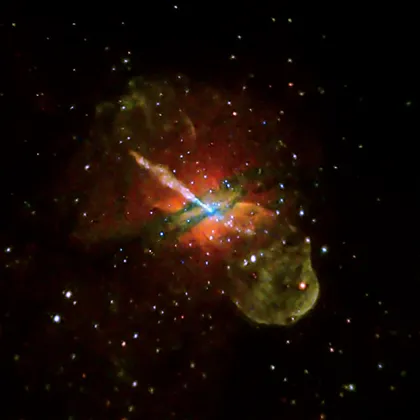
The image was made from a deep observation of the galaxy, equivalent to more than seven days of continuous observation.
A prominent X-ray jet extending more than 13 thousand light-years points to the upper left of the image, with a small jet pointing in the opposite direction. Astronomers think these jets are important vehicles for transporting energy from the black hole to the larger dimensions of the galaxy, and affecting the rate of star formation.
High-energy electrons around magnetic field lines produce X-ray emission from the jet and its counterpart. This emission quickly depletes the energy of the electrons, so they must be continuously accelerated or the X-rays would fade. In the Chandra image, knot-like objects were detected in the jets that show where particle acceleration to high energies is occurring and provides important clues to understanding the process that accelerates electrons to speeds close to that of light.
Hundreds of sources are also seen in the image. Many are X-ray binaries containing a stellar-mass black hole and a companion, orbiting each other. Determining the population and properties of these black holes should help scientists better understand the evolution of massive stars and the formation of black holes.
Another surprise was the detection of two particularly bright binaries. These sources might contain unusually massive stellar-mass black holes and this observation perhaps caught them gobbling up material at a high rate.
In the image, low-energy X-rays are colored red, intermediate ones in green, and the highest energy in blue. The dark green and blue bands running almost perpendicular to the jet are dust lanes that absorb X-rays. This dust lane was created when Centaurus A merged with another galaxy perhaps 100 million years ago.
Centaurus A, also known as NGC 5128, is a powerful radio source, located 13 million light-years from Earth, extending 60,000 light-years and located in the constellation of Centaurus.
Sources and related links
- *Chandra - Centaurus A:Jet Power and Black Hole Assortment Revealed in New Chandra Image
- *Observatorio.info:
-The Dusty Galaxy Centaurus A - -The center of Centaurus A
About the images
Credit: NASA/CXC/CfA/R.Kraft et al.