The exoplanet is between 8 and 10 million years old, a youngster compared to our planet which is 4.5 billion years old. Until now, the researchers say, no planet had been detected whose age was less than 100 million years.
"It means we are opening a new field of planet search around very young stars," says Alan Boss, a planetary formation theorist at the Carnegie Institution of Washington.
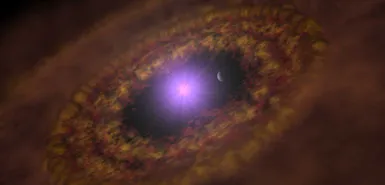
The newly discovered world resides in the star's protoplanetary disk, a ring of gas and dust orbiting the star. It was cataloged as TW Hya b.
"This demonstrates that planets can form within 10 million years before the disk has been dissipated by stellar winds and radiation," the researchers write in the January 3 issue of Nature.
With a mass close to 10 Jupiters, the planet orbits its star at a distance of almost 6 million kilometers (for comparison, Earth is an average of 150 million km from the Sun, i.e., 1 Astronomical Unit) or 0.04 AU.
The gaseous "hot Jupiter" takes only 3.56 days to orbit its star, which is located 180 light-years from Earth.
"The discovery shows that what we call protoplanetary disks are indeed that, they form planets," says researcher Johny Setiawan from the Max Planck Institute.
The researchers discovered the new world by measuring the star's "wobble" due to the gravitational pull of the planet. This radial velocity method, although very good at detecting exoplanets, can also produce false positives, suggesting the existence of an object when it may actually be another phenomenon.
Sources and related links
*Young Planet Orbits Sun-Like Star by Jeanna Bryner on Space.com
*Times online: Astronomers discover youngest ever planet
*Paper: A young massive planet in a star–disk system p38
Nature 451, 38-41 (3 January 2008) | doi:10.1038/nature06426; Received 6 July 2007; Accepted 18 October 2007
J. Setiawan, Th. Henning, R. Launhardt, A. Müller, P. Weise & M. Kürster
About the images
Graphic of the new planet. Credit: Johny Setiawan