In April, a European team of astronomers announced in Astronomy & Astrophysics the discovery of two possible habitable planets similar to Earth. That journal is now publishing two independent studies of that system that confirm that one of the planets could, in fact, be located within the habitable zone around the star Gliese 581.
More than 10 years after the discovery of the first exoplanet, astronomers have found more than 250 planets orbiting other stars. Until a few years ago, most of the discovered exoplanets were Jupiter-sized, probably gaseous. Recently, astronomers announced the discovery of several planets that are potentially smaller, with a mass less than 10 Earth masses, which are called Super-Earths [1].
In April, a team of astronomers announced in Astronomy & Astrophysics the finding of two planets orbiting the M-type star Gliese 581 (a red dwarf), with masses of at least 5 and 8 Earth masses. Given their distance to the parent star, these new planets (now known as Gliese 581 c and Gliese 581 d) were the first possible candidates for habitable planets.
Unlike giant Jupiter-type planets which are generally gaseous, terrestrial planets can be diverse: some will be dry and airless, while others will have water and gases as on our planet. Only the next generation of telescopes will allow us to see how these new worlds and their atmospheres are formed and to search for possible signs of life on them. However, theoretical research is possible today and can be of great help in identifying targets for future observations.
In this framework, Astronomy & Astrophysics now publishes two theoretical papers on the planetary system of Gliese 581. Two international teams, one led by Franck Selsis and the other by Werner von Bloh, investigated the possible habitability of two super-Earths from two different points of view. For this, they estimated the boundary of the habitable zone around Gliese 581, that is, how close and how far from the star liquid water can exist on the surface of a planet.
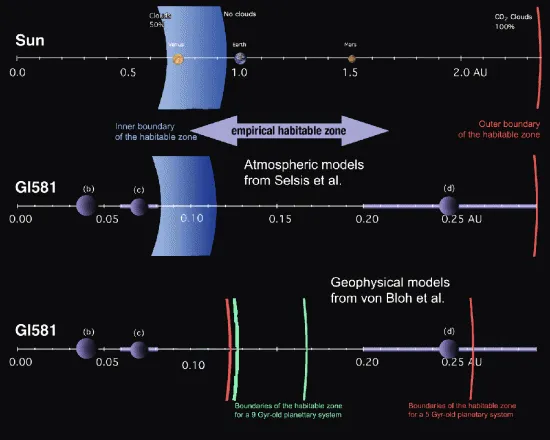
F. Selsis and his colleagues computed the properties of a planetary atmosphere at various distances from the star. If the planet is very close to the star, the water reservoir vaporizes, so life forms as on Earth cannot exist. The outer limit corresponds to the distance where carbon dioxide becomes incapable of producing the powerful greenhouse effect required to heat a planet's surface above the freezing point of water. The greatest uncertainty for this precise location of the habitable zone comes from clouds that cannot be modeled in detail. These limitations also occur when looking at the case of our Sun: climate studies indicate that the inner limit is located between 0.7 and 0.9 Astronomical Units (AU) and the outer limit between 1.7 and 2.4 AU. Figure 1 illustrates the Sun's habitable zone, compared with the case of Gliese 581 as computed by both the Selsis and von Bloh teams.
W. von Bloh and his colleagues studied a narrow region of the habitable zone where photosynthesis as on Earth is possible. This production of photosynthetic biomass depends on the atmospheric concentration of CO2, as well as on the presence of liquid water on the planet. Using a thermal evolution model for super-Earths, they computed the sources of atmospheric CO2 (released through volcanoes) and its sink (the consumption of CO2 by climatic processes). The main aspect of their model is the persistent balance (which exists on Earth) between the sink of CO2 in the atmosphere-ocean system and its release through plate tectonics. In this model, the ability to sustain a photosynthetic biosphere depends on the age of the planet, because a very old planet would no longer be active, that is, it would not release enough carbon dioxide. In this case, the planet would no longer be habitable. To compute the limits of the habitable zone as seen in figure 1, von Bloh assumed a CO2 level of 10 bars.
Figure 1 illustrates the limits of the habitable zone as computed by both models and, for comparison, the limits of the Sun's habitable zone. Both teams found that, while Gliese 581 c is too close to the star to be habitable, the planet Gliese 581 d could indeed be so. However, the environmental conditions on that planet could be too severe to allow the emergence of complex life. Something similar happens with this planet as with our Earth-Moon system: one side of the planet is permanently dark. Thus, powerful winds could be caused by the temperature difference between the day and night sides of the planet. Since the planet is located at the outer boundary of the habitable zone, life forms would have to grow with reduced stellar irradiation and a very peculiar climate.
The figure also illustrates that the distances of both planets to their central star have strong variations due to the eccentricity of their orbits. Furthermore, being close to the star, their orbital periods are short: 12.9 days for planet c and 83.6 days for planet d. The figure shows that planet d could leave and then re-enter the habitable zone during its journey. However, even under these strange conditions, it could still be habitable if its atmosphere were sufficiently dense. In any case, the conditions on that planet should be very different from what we find on Earth.
Finally, the possibility of habitability of one of these planets is particularly interesting because of its central star, which is a red dwarf, of type M. About 75% of the stars in the galaxy are of this type. They are long-lived (potentially tens of billions of years), stable and burn hydrogen. M stars have long been considered poor candidates for hosting habitable planets: first because planets located in the habitable zone of M stars are tidally locked (gravitational gradient), with one side permanently dark, where the atmosphere would likely condense irreversibly. Second, M stars have intense magnetic activity associated with violent flares and ultraviolet fluxes, during their early eras which could erode their planetary atmospheres. Theoretical studies have recently shown that the environment of M stars might not prevent these planets from hosting life. M stars have become very interesting to astronomers because habitable planets orbiting them are easier to detect via radial velocity and transit techniques than habitable planets around stars like our Sun.
Both studies definitively confirm that Gliese 581 c and Gliese 581 d will be prime targets for future missions like Darwin/Terrestrial Planet Finder (TPF) dedicated to the search for life on planets like ours. Those space observations could determine the properties of their atmospheres.
A third paper on the Gliese 581 system has recently been accepted for publication in Astronomy & Astrophysics.
In that paper, H. Beust and his team studied the dynamical stability of the system. These studies are very interesting in this framework of potential habitability of these planets because the long-term evolution of planetary orbits could regulate the climate of these planets. Mutual gravitational perturbations between different planets are present in any planetary system with more than one planet. In our solar system, under the influence of other planets, Earth's orbit evolves from purely circular to a slightly eccentric one. This is enough to initiate the alternation of warm and glacial eras. More drastic changes could prevent the development of life. Beust and his colleagues computed the orbits of the Gliese 581 system over 100 million years and found that the system appears dynamically stable, showing periodic orbital changes comparable to those of Earth. The climate on the planets is expected to be stable, so at least it does not prevent the development of life, although it does not prove it occurs either.
The papers reporting these studies are:
The habitability of super-Earths in Gliese 581, by W. von Bloh, C. Bounama, M. Cuntz, and S. Franck.
Astronomy & Astrophysics, 2007, vol. 476, p. 1365.
Habitable planets around the star Gliese 581?, by F. Selsis, J.F. Kasting, B. Levrard, J. Paillet, I. Ribas, and X. Delfosse.
Astronomy & Astrophysics, 2007, vol. 476, p. 1373.
Dynamical evolution of the Gliese 581 planetary system, by H. Beust, X. Bonfils, X. Delfosse, and S. Udry.
To be published in Astronomy & Astrophysics, 2008.
Sources and related links
About the images
Figure 1. Illustration of the habitable zone (HZ) obtained by two teams. The top part shows the HZ of the Sun (at its current age). The red curve shows only the most extreme limit of the HZ. The current outer limit is located between 1.7 and 2.4 AU. The green curve shows the limits of the photosynthetic zone computed by von Bloh et al. The middle part of the figure shows the limits of the HZ of Gliese 581 computed with the atmospheric models of Selsis et al.
The bottom part illustrates the limits of the photosynthetic zone computed with the geophysical models of von Bloh et al. The limits are shown for several possible ages (5, 7 and 9 Gyr) of the Gliese 581 system. According to the latest estimate, Gliese 581 would be 7 Gyr. (1 Gyr = 109 years or one billion years) The purple lines around planets c and d illustrate the variable distance to the star caused by the eccentricity of their orbits.
Copyright Astronomy & Astrophysics.