The Hubble Space Telescope provided new elements to better understand the atmosphere of an exoplanet. The observations provide evidence for the existence of haze in the atmosphere of the planet HD 189733b.
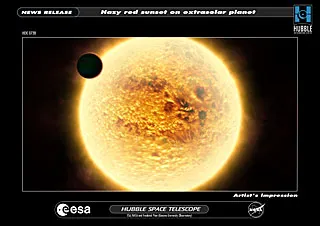
A team of astronomers used Hubble to detect, for the first time, strong evidence of hazes in the atmosphere of this planet. The discovery was made after many observations made with the ACS camera of the Space Telescope.
The team, led by Frédéric Pont of the Geneva University Observatory in Switzerland, says "One of the goals of studying planets is to measure the atmosphere of an Earth-like planet and this result is a step in that direction. HD 189733b is the first exoplanet for which we are generating a complete idea of what it looks like".
The new observations were made when the planet passed in front of its host star in a transit. As the star's light passed through the atmosphere of the giant planet, the gases in the atmosphere stamped their particular signature on the light.
The planet orbiting close to its star is a gas giant type larger than Jupiter. The proximity to its star results in a high atmospheric temperature of almost 700 degrees Celsius. Measurements of the light wave vary as it passes in front of its star indicating that HD 189733b has no natural satellites the size of our Moon nor a distinguishable ring system.
Where scientists expected to see the signatures of sodium, potassium and water in the precise measurements made in the planet's spectrum, they found nothing. This, in combination with the distinct shape of the planet's spectrum, allows inferring the presence of high-level haze (with an altitude range of 1000km). So the atmosphere on HD 189733b would look similar to the wonderful red sunset over Athens!
Venus and Titan (moon of Saturn) in our solar system are also covered in haze. According to scientists this haze consists of small particles (less than 1/1000 mm in size) of iron condensates, silicates and aluminum oxide dust (the component on Earth of which the mineral sapphire is made).
As part of the observations, the teams of astronomers also needed to accurately account for variations in the starlight during them. Sunspots like those seen on our Sun would cover a large percentage of the star and are thought to be about 1000 degrees Celsius cooler than the rest of the stellar surface. One of the spots found is over 80,000 km!
Sources and related links
About the images
Artistic impression of the planet transiting in front of its parent star.
Credit:ESA, NASA and Frederic Pont (Geneva University Observatory)