Using the interferometer of ESO's Very Large Telescope, astronomers have investigated the innermost parts of the disk of matter around a young star, witnessing how it gains mass before becoming an adult.
The astronomers observed the object known as MWC 147, which lies 2,600 light-years away toward the constellation of Monoceros (The Unicorn). MWC 147 belongs to the family of Herbig Ae/Be objects. These have a few times more mass than our Sun and are in formation, growing in mass by absorbing material present in a disk that surrounds them.
MWC 147 is less than half a million years old. If the middle age of our Sun of 4.6 billion years is associated with a person in their forties, MWC 147 would be a one-day-old baby.
The morphology of the closest environment of this young star is, however, a matter of debate.
The astronomers used the four 8.2-meter telescopes of the VLT, combining the light from two or three telescopes with the MIDI and AMBER instruments.
"We combined, for the first time, near- and mid-infrared observations of a Herbig Ae/Be star, measuring the size of the disk over a wide range of wavelengths," said Stefan Kraus, author of the paper reporting the results. "The different wavelength regimes trace different temperatures, allowing us to probe the geometry of the disk on a small scale, but also to constrain how the temperature changes with distance from the star."
The near-infrared observations probe hot material with temperatures of a few hundred degrees in the innermost regions of the disk, while the mid-infrared observations trace colder regions.
The observations show that the temperature changes with radius in a more step-like fashion than predicted by current models, indicating that most of the near-infrared emission emerges from hot material located very close to the star, between one and two times the Earth-Sun distance (1-2 Astronomical Units, AU). It also implies that dust cannot exist so close to the star since the strong radiated energy heats and ultimately destroys the dust grains.
"We performed detailed numerical simulations to understand these observations and came to the conclusion that we are not observing only the outer dust disk, but we are measuring powerful emissions from a hot inner gaseous disk. This suggests the disk is not a passive one. Instead, the disk is active and we see material that was transported from the outermost parts of the disk toward the forming star."
The model that best fits is that of a disk extending about 100 AU with a star increasing in mass at a rate of seven millionths of a solar mass per year.
"Our study demonstrates the power of ESO's VLTI to investigate the internal structure of disks around young stars and to reveal how the star reaches its final mass," added Kraus.
Sources and related links
- *ESO: The Growing-up of a Star
- *The results were reported in the paper "Detection of an inner gaseous component in a Herbig Be star accretion disk: Near- and mid-infrared spectro-interferometry and radiative transfer modeling of MWC 147", by Stefan Kraus, Thomas Preibisch, Keichii Ohnaka, accepted for publication in Astrophysical Journal.
About the images
ESO PR Photo 03a/08 (the first image)
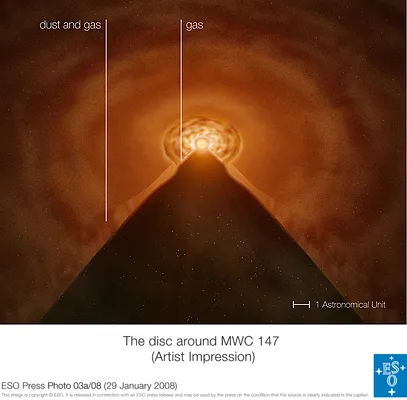
Artist's impression of the disk of matter around MWC 147, inferred from observations with ESO's Very Large Telescope Interferometer. A portion was removed to better show the internal structure. The dust in the outer part emits mostly in the mid-infrared wavelength, while near the star there is strong near-infrared emission from the very hot gas. This gas is transported toward the forming star, increasing its mass.
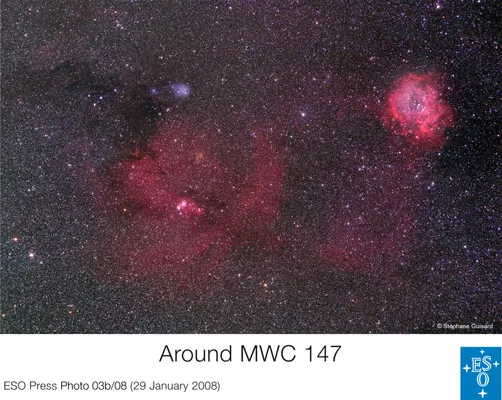
ESO PR Photo 03b/08: Around MWC 147
Image by © Stéphane Guisard "Los Cielos de Chile"
The Cone and Rosette region
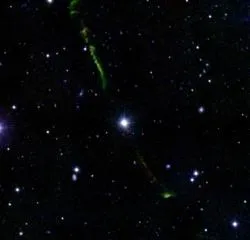
Wide-field image taken by Stéphane Guisard (ESO) of the NGC 2247 region containing the Herbig Ae/Be object MWC 147: The Cone Nebula in the center and the Rosette Nebula, top right, can be seen, both in the constellation Monoceros, near the constellation Orion. The star MWC 147 is near the dark nebula, in the upper left part of the image and belongs to an association of massive stars, known as the Monoceros OB1 association.
On Stéphane Guisard's site, an image of excellent resolution and size can be seen, in which I recommend observing something very simple but incredibly striking: the number of stars perceived in the photo, which reminds me of Carl Sagan's famous phrase that the number of stars is like the grains of sand on all the beaches of the world. One already knows it, but there are images -like this one- that make it clearly visible.
PS: It is clear that, in reality, the stars are not "clumped" together as it might seem to be perceived in the photo. It is an image and therefore lacks the third dimension. And as they rightly say (we think the same) on NASA Watch, stars are very common, there are so many, that even if the requirements for life were rare and extraordinary, the possibilities are still enormous, given the number of stars...