A strange and violent fate awaits a white dwarf that wanders too close to a moderate-mass black hole. According to a new study, the gravitational pull of the black hole on the white dwarf would cause enough tidal forces to disrupt the stellar remnant and re-ignite nuclear combustion in the star, giving rise to a supernova explosion with an unusual appearance. The observation of those supernovae could confirm the existence of intermediate-mass black holes, currently a matter of debate among astronomers.
"Our computer simulations show that a peculiar supernova would be the distinctive signature of an intermediate-mass black hole," says Enrico Ramírez-Ruíz, a professor at the University of California, Santa Cruz.
Ramírez and his collaborators used detailed computer simulations to follow the complete process of the tidal disruption of a white dwarf by a black hole. Their simulations include gas dynamics, gravity and nuclear physics, requiring weeks of computer time to simulate events that would last a fraction of a second. A paper describing their results has been accepted for publication in Astrophysical Journal Letters and a preprint is currently available online.
"Every star that is not too massive ends up as a white dwarf, so they are very common. We were interested in whether tidal disruptions could revive the stellar corpse," says Stephan Rosswog, first author of the paper.
A white dwarf can explode as a type Ia supernova if it accumulates enough mass by drawing material from a stellar companion. When it reaches the critical mass (about 1.4 times the mass of the Sun, which is called the Chandrasekhar limit), the white dwarf collapses and explodes. Astronomers use this type of supernova as "standard candles" for cosmic distance measurements because their brightness evolves over time in a predictable way.
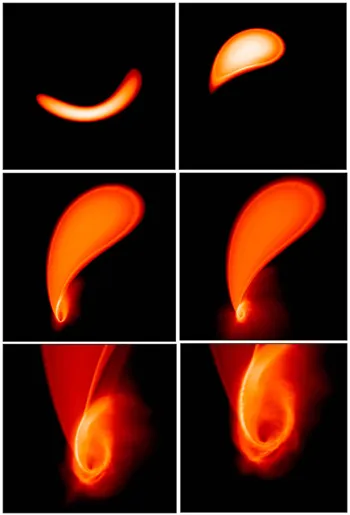
The new paper describes a different mechanism for igniting a white dwarf, in which the tidal disruption by a black hole causes a drastic compression of the stellar material. The white dwarf is crushed into a pancake shape aligned in the plane of its orbit around the black hole. As each section of the star is squeezed through a point of maximum compression, the extreme pressure causes a sharp increase in temperature, which triggers explosive combustion.
The explosion ejects more than half of the star's debris, while the rest of the material falls into the black hole. The falling material forms a luminous accretion disk that emits X-rays and should be detectable by the Chandra X-ray Observatory, according to the researchers.
Ramírez-Ruíz estimates that this type of event would occur about 100 times less frequently than standard type Ia supernovae, but would be detectable by future surveys designed to observe a large number of supernovae. The Large Synoptic Survey Telescope (LSST), planned for 2013, could detect hundreds of thousands of type Ia supernovae per year.
The mechanism described in the paper requires a black hole that is neither very small nor very large. Such intermediate-mass black holes (500 to 1000 times the mass of the Sun) could reside in some globular clusters, but there is less evidence for their existence than for the relatively small black holes (tens of times the mass of the Sun) or for supermassive black holes (about millions of solar masses), found in the centers of galaxies.
The new paper describes in detail the disruption of a white dwarf with two tenths of the mass of the Sun by a 1000 solar mass black hole. The researchers also found that they can vary the mass of the white dwarf and still arrive at the same result.
Sources and related links
- *EurekAlert:Unusual supernovae may reveal intermediate-mass black holes in globular clusters
- *University of California:Unusual supernovae may reveal intermediate-mass black holes in globular clusters
- *Atypical Thermonuclear Supernovae from Tidally Crushed White Dwarfs
Stephan Rosswog, Enrico Ramirez-Ruiz, and William R. Hix
DOI: 10.1086/apjl22327
About the images
Image from the University of California, Santa Cruz page
The series of images show the interaction of a white dwarf with a black hole. As it passes close to a black hole, the white dwarf becomes strongly compressed and heated (top left), triggering an explosion. Most of the stellar mass is ejected into space (the "bubble" in the upper right part of the debris in the top-right image), while the rest falls toward the black hole. As the ejected material expands rapidly, the falling material creates an accretion disk around the black hole.