An unusual star may have swallowed its stellar companion and, as a result, formed a cloud of planetary formation, a new study suggests.
The star, called BP Piscium, is surrounded by a dense disk of gas and dust from which it appears to be drawing new material at a prodigious rate.
These properties are typical of young stars, but BP Piscium appears to be much older, based on the weak lithium signals in its light spectrum. Young stars have a lot of lithium, unlike older ones.
A team of scientists led by Carl Melis of UCLA reported the unusual star at the Meeting of the American Astronomical Society in Texas in January.
Now, Benjamin Zuckerman, also from UCLA, together with Melis and others, have made public a more detailed study of the star.
The researchers believe the star is a middle-aged one that exhausted its hydrogen and swelled to become a giant.
The distance to the star was not measured directly, but the observations agree with a star weighing about 1.8 times the mass of the Sun and lying about 1000 light-years away. Based on the distance, they calculated that the dust disk contains the mass of almost 50 planets like ours.
To explain the presence of the dust disk, the astronomers suggest that when the star grew into a red giant, its atmosphere engulfed its stellar companion. The companion, orbiting within the atmosphere of the primary star, would have stirred the gas there and ejected it to form a disk. The disk could then form planets, as disks around very young stars do.
Furthermore, the astronomers identified another old star with a dust disk, called TYCHO 4144 329 2, which would have gone through a similar scenario.
The team observed the two stars with the Hubble Space Telescope and are analyzing the results. They are also trying to make observations with the Chandra X-ray Observatory, which would allow them to know more about the ages of the systems, since young stars have much greater X-ray activity than older ones.
Sources and related links
- *NewScientist:Star eats star and builds planets from the crumbs
- *Gas and Dust Associated with the Strange, Isolated, Star BP Piscium;
B. Zuckerman et al.
About the images
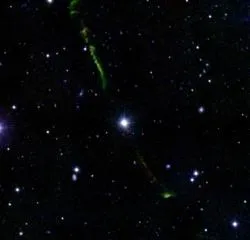
Matter jets from the star BP Piscium, in an image made with the 3-meter telescope at Lick Observatory.
Credit:: Marshall Perrin/UCLA/James Graham/UC Berkeley