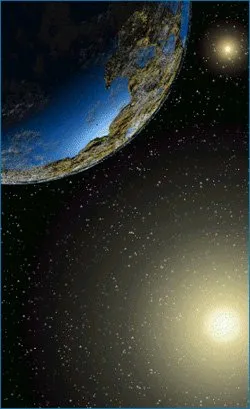
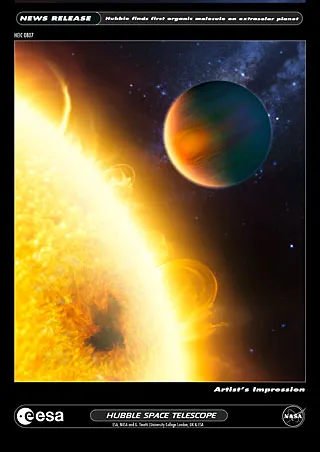
Astronomers have discovered that terrestrial planets would form around many, if not most, of the nearby stars like the Sun in our galaxy. These new results suggest that worlds with potential life would be more common than previously thought.
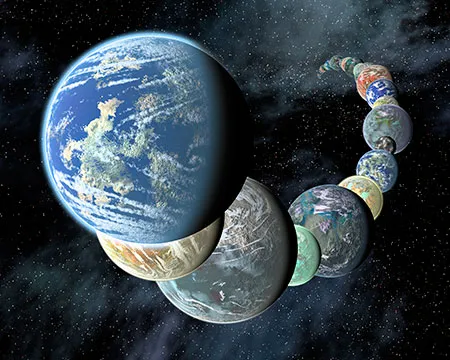
Michael Meyer, an astronomer at the University of Arizona, and his colleagues, used the Spitzer Space Telescope to determine whether planetary systems like ours are common or rare in our Milky Way. They found that at least 20% and possibly up to 60% of Sun-like stars are candidates for forming rocky planets.
Meyer will present his discoveries at the annual meeting of the American Association for the Advancement of Science in Boston. The results appear in the February 1st edition of Astrophysical Journal Letters.
The astronomers used Spitzer to probe six sets of stars, grouped according to their age, with masses comparable to our Sun. Our star is about 4.6 billion years old. "We wanted to study the evolution of gas and dust around stars similar to our Sun and compare the results with what we think the solar system looked like in early stages of its evolution," says Meyer.
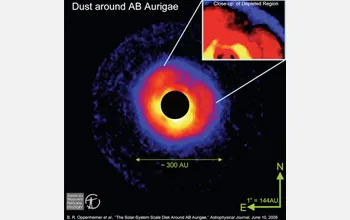
The Spitzer telescope does not detect planets directly. Instead, it detects dust in an infrared wavelength range. The hottest dust is detected at the shortest wavelength, between 3.6 and 8 microns. In contrast, the coldest dust is detected at longer wavelengths, between 70 and 160 microns. Warm dust can be traced at a 24-micron wavelength. Since dust close to a star is hotter than that farther away, the "warm" dust is a likely trace of material orbiting the star at a distance comparable to that between Earth and Jupiter.
"We found that about 10 to 20 percent of the stars in each of the four youngest groups show 24-micron emission due to dust. But we don't frequently see warm dust around stars older than 300 million years," adds Meyer.
"That is comparable to the timescale thought for the formation and dynamic evolution of our solar system. Theoretical models and meteorite data suggest that Earth formed between 10 to 50 million years from the collision of smaller bodies."
In a separate study, Thayne Currie and Scott Kenyon of the Smithsonian Astrophysical Observatory, and their colleagues, also found evidence of dust from terrestrial planet formation around stars between 10 to 30 million years old. "These observations suggest that whatever led to the formation of Earth could be happening around many stars between 3 and 300 million years old," noted Meyer.
Kenyon and Ben Bromley of the University of Utah developed planetary formation models that provide a plausible scenario. Their models predict that warm dust could be detected at a 24-micron wavelength from the collision and merging of small rocky bodies. "Our work suggests that the warm dust that Meyer and his colleagues detected is a natural result of rocky planet formation. We predict a higher frequency of dust emission for younger stars, just as Spitzer observes," added Kenyon.
The numbers of how many stars form planets are ambiguous because there is more than one way to interpret the Spitzer data, according to Meyer. The observed emission around 20% of the stars could persist with the star's age. That is, the warm dust generated by collisions around stars 3 million to 10 million years old could persist in stars between 10 million to 30 million years old. Interpreting the data this way, about one in five Sun-like stars is potentially forming planets, explains Meyer.
But there is another way to interpret the data. "An optimistic scenario could suggest that the largest and most massive disks would carry out the collision process first and assemble their planets quickly. That is what we might be seeing in the youngest stars. Their disks die young, shining early and then becoming diffuse. However, the smaller and less massive disks would shine later. Planet formation in this case is delayed because there are fewer particles to collide with each other."
If this is correct and the more massive disks form their planets first and the smaller ones take between 10 to 100 times longer, then up to 62% of the stars surveyed have formed or may be forming planets. "The correct answer probably lies between the pessimistic case of less than 20% and the optimistic one of more than 60%," says the scientist.
The upcoming Kepler mission could add data to answer the question of how many planets like ours could be formed or forming out there.
Sources and related links
- Spitzer: Many, Perhaps Most, Nearby Sun-Like Stars May Form Rocky Planets
- Evolution of Mid‐Infrared Excess around Sun‐like Stars: Constraints on Models of Terrestrial Planet Formation
M. R. Meyer et al.
The Astrophysical Journal, 673:L181–L184, 2008 February 1
DOI: 10.1086/527470 - AAAS: Astronomers Look for Earth-Like Worlds
About the images
NASA/JPL-Caltech/R. Hurt (SSC-Caltech)