The Hubble Space Telescope made the first detection of an organic molecule in the atmosphere of a planet orbiting another star. This is a step forward in identifying signs of life on a planet outside our solar system.
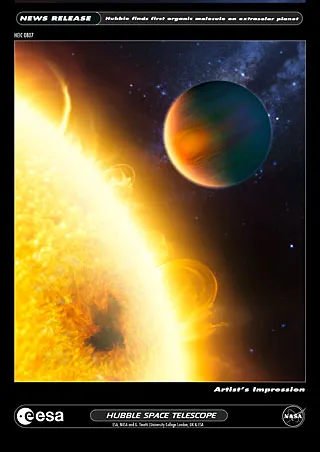
The signature of the methane molecule was found in the atmosphere of a Jupiter-sized exoplanet, called HD 189733b. Under the right circumstances, methane can play a key role in prebiotic chemistry - the chemical reactions considered necessary to form life as we know it. Although methane has been detected on most of the planets in our solar system, this is the first time any organic molecule has been detected on a world orbiting a star other than the Sun.
The discovery proves that Hubble and upcoming space missions like the James Webb Space Telescope can detect organic molecules on exoplanets by using spectroscopy.
"This is a crucial step toward eventually characterizing prebiotic molecules on planets where life could exist," says Mark Swain of NASA's Jet Propulsion Laboratory (JPL), who led the team that made the discovery. Swain is the author of a paper in the March 20 issue of Nature.
The finding was made after extensive observations in May 2007 with Hubble's NICMOS camera. It also confirms the existence of water molecules in the planet's atmosphere, a discovery originally made by the Spitzer Space Telescope last year.
The planet is located 63 light-years away in the constellation Vulpecula. It is a "hot Jupiter" type planet, so close to its star that it only takes one or two days to complete an orbit. This type of planet is the size of Jupiter but orbits much closer to its stars than Mercury does in our solar system. The atmosphere of HD 189733b is roasting at about 900 degrees Celsius, almost the same temperature as the melting point of silver.
The observations were made as the planet passed in front of its star, in what is called a "transit." As the star's light briefly passed through the atmosphere along the edge of the planet, the gases in the atmosphere imprinted their signatures on the sunlight. According to co-author Giovanna Tinetti of University College London and ESA, "Water alone cannot explain the observed spectral features. The additional contribution of methane is necessary to match the Hubble data."

Methane, composed of carbon and hydrogen, is one of the main components of natural gas, a petroleum product. On Earth, methane is produced by a variety of sources: natural sources like termites, oceans and swamps, but also from livestock and human sources like landfills and as a byproduct of energy generation. Tinetti is, however, quick to rule out a biological origin for the methane found, given the extremely high temperature of the planet's atmosphere.
Astronomers were surprised to find that the planet has more methane than predicted by conventional models for "hot Jupiter" type planets. This type of planet should have more carbon monoxide than methane, but in this case it is not so. Tinetti explains: "A sensible explanation is that the Hubble observations were more sensitive to the dark night side of the planet where the atmosphere is a bit cooler and the photochemical mechanisms responsible for methane destruction are less efficient than on the day side."
The ultimate goal is to be able to apply spectroscopy to identify prebiotic molecules in the atmospheres of planets located in the habitable zones around other stars, where temperatures are right for water to remain liquid and not frozen or evaporated.
This is not the first time the planet has caught the attention of astronomers. On previous occasions, Hubble studied the red sunset of this planet and Spitzer detected water in its atmosphere, a finding now confirmed.
Sources and related links
- SpaceTelescope:Hubble finds first organic molecule on extrasolar planet
- The presence of methane in the atmosphere of an extrasolar planet
Nature 452, 329-331 (20 March 2008) | doi:10.1038/nature06823;
Received 14 September 2007; Accepted 6 February 2008
Mark R. Swain, Gautam Vasisht & Giovanna Tinetti
About the images
Artist's impression of HD 189733b.
Credit:ESA, NASA and G. Tinetti (University College London, UK & ESA)
Photo of Dr Giovanna Tinetti at STFC