Astrophysicists observed a circumstellar disk with signs that would reveal planetary formation orbiting the star AB Aurigae. Planet or brown dwarf?
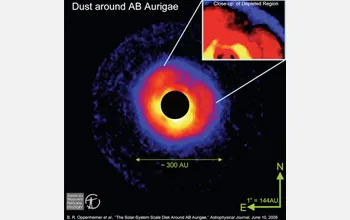
Ben R. Oppenheimer, assistant curator at the American Museum of Natural History in the U.S., and his colleagues used the Lyot coronagraph attached to the U.S. Air Force telescope in Maui, Hawaii, to build an image of material assembling into a body, from the cloud of gas and dust around AB Aurigae, a well-known star. The body is either a planet or a brown dwarf, a low-mass star. Brown dwarfs have been found orbiting stars since a team that included Oppenheimer detected one in 1995.
The research results, accepted for publication in the June edition of Astrophysical Journal, represent a significant step toward the direct observation and study of exoplanets orbiting stars other than the Sun and could advance theories of planetary formation.
Young stars generally have a lot of material captured by their gravitational pull, which organizes into a disk over time. Astronomers believe that planets form in that circumstellar disk.
The image produced by the team shows a horseshoe-shaped void in the disk with a bright spot. "The deficit of material could be due to planetary formation, by removing material and gathering it into a small spot in the image, and the removal of material from the immediate environment. It seems to be indicative of the formation of a small body, either a planet or a brown dwarf," explains the scientist.
AB Aurigae is a young star, between one and three million years old and therefore provides information about how stars and the objects that orbit them form. An unresolved question about planetary formation is how the initial, dense, gas-rich disk evolves into a thin, dusty disk with planets. The observation of stars a little older than AB Aurigae shows that at some point the gas is removed, but no one knows how it happens. AB Aurigae could be at an intermediate stage, where the gas is being removed from the center, leaving mainly dust behind.
"More detailed observations of this star can help resolve questions about how planets form and could test competing theories. And if the object is a brown dwarf, our understanding of them should be reconsidered, since brown dwarfs are not thought to form in circumstellar materials," concludes the scientist.
Sources and related links
EurekAlert: A planet in progress?
Accepted paper:
The Solar-System-Scale Disk around AB Aurigae
Ben R. Oppenheimer, Douglas Brenner, Sasha Hinkley, Neil Zimmerman, Anand Sivaramakrishnan, Remi Soummer, Jeffrey Kuhn, James R. Graham, Marshall Perrin, James P. Lloyd, Lewis C. Roberts, Jr., and David M. Harrington
Received: 26 Oct 2007Accepted: 22 Feb 2008
About the images
Coronagraphic image of polarized light around the star AB Aurigae, showing the distribution of dust in the inner part of a complex disk of material around the star. The central region is blocked to block the light from the star.
Note the scale of the image, indicated with an arrow, which corresponds to 300 times the average distance between Earth and the Sun!
Credit: The Lyot Project
A higher quality image can be obtained on the National Science Foundation site: A planet in progress?