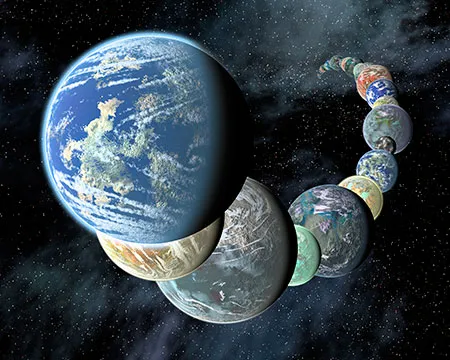
A rocky planet like Earth could be orbiting one of our nearest stars, Alpha Centauri, and could be detectable using existing techniques, according to a new study led by astronomers from the University of California, Santa Cruz (UCSC).
The stars closest to our Sun are in the three-star system Alpha Centauri.
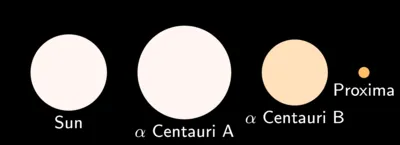
The system is composed of Alpha Centauri A, a yellow star of the same type as the Sun, and Alpha Centauri B, an orange K-type star. The third star is Proxima Centauri, which orbits the previous two at a much greater distance. As their names indicate, they belong to the constellation of Centaurus and the system is located 4.3 light-years from Earth.
Javiera Guedes, from UCSC, used computational simulations of planetary formation to show that terrestrial planets are likely to have formed around Alpha Centauri B and to be orbiting in the "habitable zone" where liquid water can exist on the surface of the supposed planet. Then the researchers showed that those planets could be observed using a dedicated telescope.
"If they exist, we can observe them," said Guedes, one of the authors of a paper describing the new discoveries that has been accepted for publication in Astrophysical Journal.
Co-author Gregory Laughlin, also from UCSC, said that a number of factors converge to make Alpha Centauri B an excellent candidate for finding terrestrial planets. The Doppler detection method, which has revealed most of the 228 known exoplanets, measures the shift in a star's light to detect the small "wobbles" induced by the gravitational influence of a planet. Some factors favor the use of this technique on Alpha Centauri B, such as the star's brightness and its position in the sky, which allows for a long observation period each year from the Southern Hemisphere, explains Laughlin.
Detecting small rocky planets the size of Earth is a real challenge, however, because they induce a very small gravitational influence on their host stars. According to Laughlin, five years of observation using a dedicated telescope would be necessary to detect such a planet around Alpha Centauri B.
Co-author Debra Fischer of San Francisco State University is leading an observational program to intensively monitor Alpha Centauri using the 1.5-meter telescope at the Cerro Tololo observatory in Chile. The researchers hope to detect real planets, similar to those that emerge from the computational simulations.
"I think the planets are there, and it's worth trying to observe," says Laughlin hopefully.
To study planetary formation around Alpha Centauri B, the team ran repeated computational simulations, evolving the system for the equivalent of 200 million years each time. Given the variations in the initial conditions, each simulation leads to the formation of a different planetary system. In each case, however, a system of multiple planets evolved with at least one planet approximately the size of Earth. In many cases, the simulated planets have orbits that lie in the star's habitable zone.
Sources and related links
- UCSC:Nearby star should harbor detectable, Earth-like planets
- Paper (PDF)
Formation and Detectability of Terrestrial Planets around Alpha Centauri B
Guedes, J. M., Rivera, E. J., Davis, E., Laughlin, G.
About the images
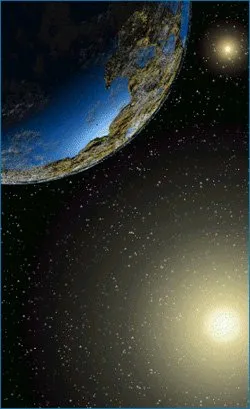
The top image is an illustration by Mark Fisher of a planet in the Alpha Centauri system.
Image from Wikipedia
Comparison of the size and color of the three stars of Alpha Centauri with our sun. Credit:David Benbennick